
THE WEIGHT OF THE UNCONSCIOUS: WHEN 'THE NIGHTMARE' ESCAPED THE CANVAS
In the late 18th century, a single painting captured the paralyzing terror of the human mind. Henry Fuseli's masterpiece didn't just depict a bad dream; it gave a physical form to sleep paralysis and our deepest psychological fears. Decades later, that very nightmare was dragged into the three-dimensional world, proving that our darkest imaginations refuse to stay trapped in paint.
Have you ever woken up in the dead of night, unable to move, feeling an invisible, crushing weight pressing down on your chest? Centuries before modern science could fully define or explain the terrifying physiological phenomenon of sleep paralysis, the European art world attempted to capture its absolute horror on canvas.
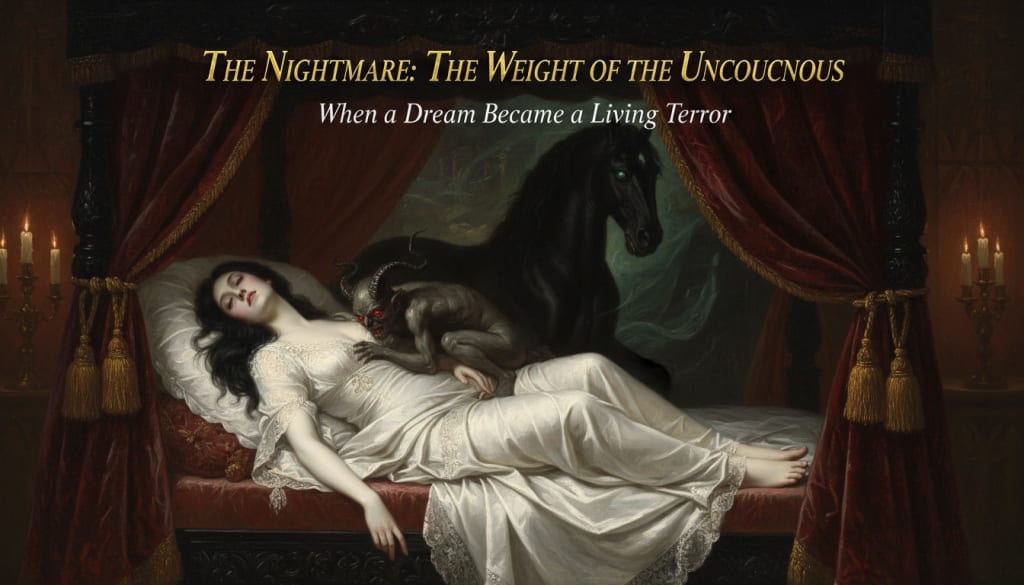
In the late eighteenth century, specifically around 1781, a Swiss-born artist named Henry Fuseli unveiled a painting that would forever alter the landscape of Romantic art. He called it simply, The Nightmare. When you look at the bottom half of the image, you are witnessing Fuseli’s original, haunting vision. A woman dressed in a flowing white nightgown lies draped across a bed in a deep, unnatural swoon. Her body is entirely limp, her head thrown back, and one arm hangs heavily off the edge of the mattress, leaving her completely vulnerable to the dark forces of the night. But it is not her vulnerable posture that immediately draws the eye and chills the blood—it is the grotesque, demonic incubus crouching directly upon her chest.
Adding to the suffocating and claustrophobic atmosphere of the scene, a ghostly horse with hollow, glowing eyes violently thrusts its head through the heavy velvet curtains in the background. The painting was scandalous, terrifying, and utterly mesmerizing to the public. It wasn't a traditional religious or historical scene, which was the rigid standard of the era. Instead, it was a raw, unfiltered dive into the darkest corners of the human subconscious. Fuseli managed to paint the exact feeling of psychological anxiety, repressed desires, and the heavy, paralyzing dread of a night terror.
However, the image was so powerful and visceral that it refused to remain confined to a flat, two-dimensional canvas. Decades later, the chilling allure of The Nightmare deeply inspired a German sculptor named Emil Eduard Hammer to do the unthinkable: he brought the painting out of the frame and into the real world.
As seen in the top half of the split image, Hammer recreated Fuseli’s masterpiece as a life-sized, three-dimensional wax diorama. He meticulously crafted the swooning woman, the delicate, intricate fabrics of her white gown, and the menacing, monkey-like creature sitting heavily upon her. This tangible nightmare was displayed in his famous Panopticon in Munich. During the nineteenth century, these Panopticons were wildly popular public exhibitions where history, art, and the macabre were brought to life in wax for the masses to consume. Hammer took a psychological terror and made it something people could actually walk around, look at from different angles, and feel a disturbing physical proximity to.
Today, this incredible wax recreation is carefully preserved in the Valentin-Karlstadt-Museum. It stands as a fascinating, haunting bridge between two distinct artistic mediums. When you look at the comparison—the raw, painted nightmare below and the lifelike, physical recreation above—you realize that art is the only language capable of translating the invisible horrors of the human mind into something we can all collectively witness. Dreams and nightmares have always been a fundamental part of the human experience, but it takes true artistic genius to make us stare our night terrors right in the eyes, both on a canvas and in the physical space of a room.
About the Creator
Wellova
I am [Wellova], a horror writer who finds fear in silence and shadows. My stories reveal unseen presences, whispers in the dark, and secrets buried deep—reminding readers that fear is never far, sometimes just behind a door left unopened.
'Till Death We Do Art
There would be nothing divine in this world without art. Nature may surpass the divine to all intents and purposes, but like everything it absorbs and is absorbed by, it remains here, stuck on the surface of this world, ever-present, physically bound to the universe.
By Avocado Nunzella BSc (Psych) -- M.A.P 24 days ago in Art
The Front Seat
I found myself waking up in the front seat of the bus. My eyes were filled with the early morning darkness. I had been asleep, but I wasn’t sure for how long. I tried to wake up my body, but my head felt heavy, as though I had been sleeping for an eternity, although I couldn’t pinpoint how much time had passed.
By Aunty Sadaabout 13 hours ago in Art
Why Didn't Anyone Tell Us
Men, move along. This is not for you. This is for the women. I was forty-five when I began menopause. It is pretty young for that to be going on in a woman’s life, but I had undiagnosed PCOS, my entire life. Thank you to all the gynecologists I had seen my entire life. That in itself should encourage women to keep seeking second opinions, especially when you are not getting correct answers or any at all.
By Alexandra Grant2 days ago in Humans



Comments
There are no comments for this story
Be the first to respond and start the conversation.