
The Giant Beneath the Ceiling
Known as “Hope,” the massive blue whale skeleton suspended in the Natural History Museum symbolizes both the grandeur of nature and the urgent need to protect Earth’s largest creatures.

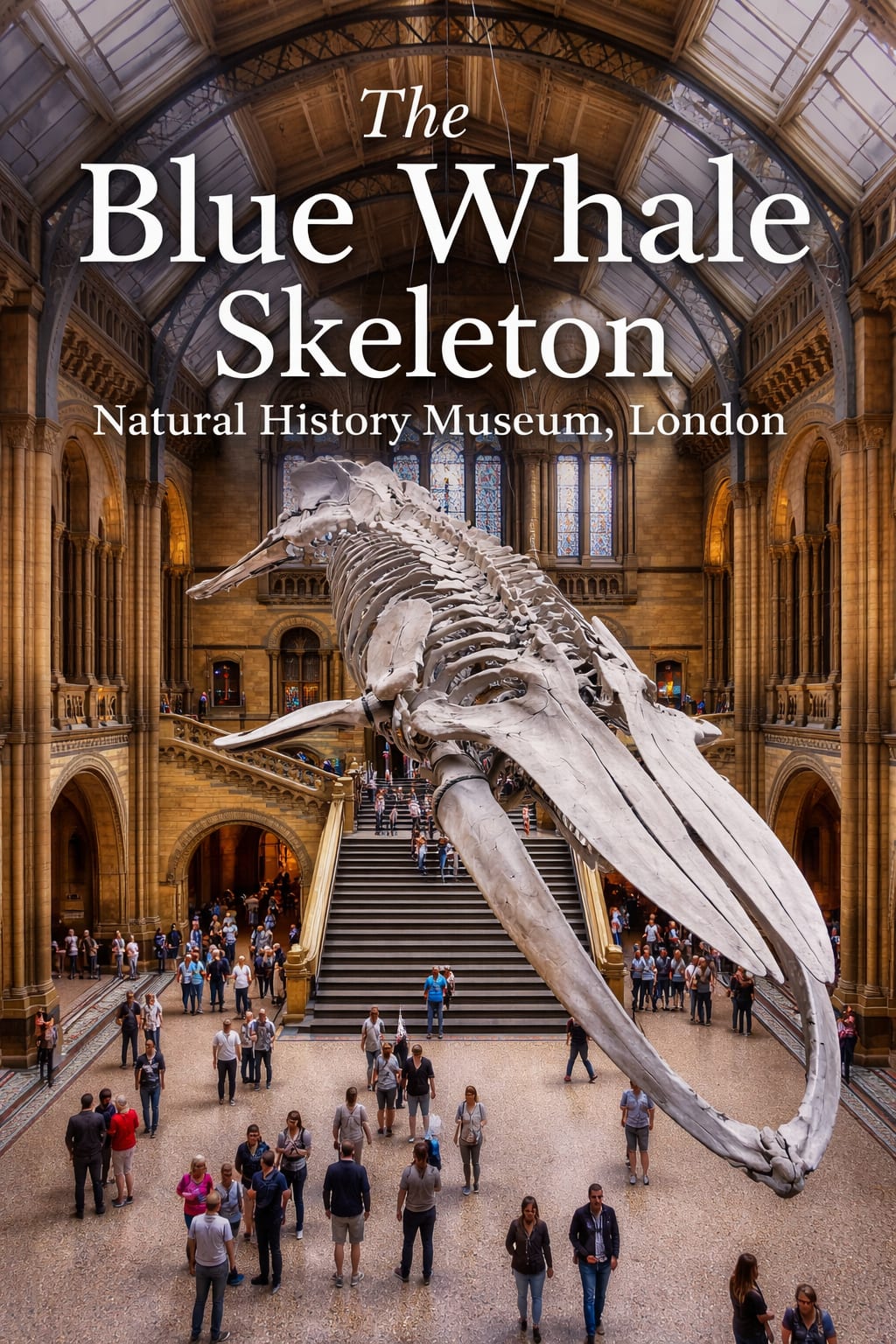
At the heart of the Natural History Museum in London, visitors entering the magnificent Hintze Hall are greeted by a breathtaking sight: the enormous skeleton of a blue whale suspended from the ceiling. This remarkable display, known as “Hope,” represents not only the largest animal ever known to have lived on Earth but also a powerful message about conservation and humanity’s relationship with nature.
The blue whale, scientifically known as Blue Whale, can grow up to 30 meters (about 98 feet) long and weigh more than 170 tons. Its heart alone can weigh as much as a small car, and its tongue may weigh as much as an elephant. Despite their immense size, blue whales are gentle giants that feed primarily on tiny shrimp-like creatures called krill. Their presence in the oceans reflects the incredible diversity and scale of life on our planet.
The skeleton displayed in the museum measures approximately 25.2 meters (about 83 feet) in length. It originally belonged to a young female blue whale that became stranded in 1891 at Wexford Harbour in Ireland. After the whale’s remains were recovered, the skeleton eventually became part of the museum’s collection. For decades, however, it was stored away and rarely displayed.
For much of the 20th century, visitors to the museum’s central hall were greeted by the enormous skeleton of a Diplodocus, affectionately nicknamed “Dippy.” This dinosaur replica became one of the museum’s most famous attractions. But in 2017, the museum decided to redesign the hall to highlight modern environmental themes and the wonders of living nature. As part of this transformation, Dippy was moved to a touring exhibition, and the blue whale skeleton was carefully restored and installed in its place.
Suspended dramatically from the ceiling, the skeleton appears as if it is diving through the hall. Engineers and conservation specialists worked meticulously to position the bones accurately while ensuring the display could safely hang above thousands of daily visitors. The result is both a scientific exhibit and a piece of architectural art. Standing beneath it, visitors often feel a sense of awe, realizing how small humans are compared with the largest creature ever to inhabit the planet.
The whale skeleton was named “Hope” to symbolize optimism about the future of the natural world. During the 20th century, blue whales were hunted extensively by commercial whaling fleets. Their enormous size and valuable oil made them prime targets, leading to a drastic decline in their population. By the mid-1900s, blue whales were on the brink of extinction.
International agreements eventually helped protect them. The International Whaling Commission introduced a ban on commercial whaling in 1986, giving blue whale populations a chance to recover. Although their numbers remain far below historical levels, conservation efforts have helped stabilize many populations. Today, the species is still classified as endangered, but there is cautious optimism that these majestic animals may continue to recover.
The display of Hope in Hintze Hall serves as a reminder of both human impact and human responsibility. Museums traditionally focused on collecting and displaying specimens, but modern institutions also play an important role in education and environmental awareness. By showcasing the blue whale skeleton so prominently, the museum encourages visitors to think about marine conservation, climate change, and the fragile ecosystems of the world’s oceans.
Beyond its environmental message, the skeleton is also a masterpiece of biological design. Each of the whale’s enormous vertebrae and ribs reveals how evolution shaped a creature capable of living entirely in the ocean while remaining a mammal. The skeleton also helps scientists study whale anatomy and understand how such massive animals move, dive, and communicate through the deep seas.
For millions of visitors every year, standing beneath the giant skeleton is an unforgettable experience. Children and adults alike gaze upward at the massive bones, imagining the living creature that once swam through the oceans. In that moment, the display does more than showcase natural history—it connects people emotionally with the wonders of the natural world.
The blue whale skeleton in London’s Natural History Museum therefore represents more than a preserved specimen. It is a symbol of nature’s magnificence, the lessons of history, and the hope that humanity can protect the extraordinary life that shares our planet.
About the Creator
Irshad Abbasi
Ali ibn Abi Talib (RA) said 📚
“Knowledge is better than wealth, because knowledge protects you, while you have to protect wealth.
Keep reading
More stories from Irshad Abbasi and writers in Earth and other communities.
The Ancient Meteorite That Changed Earth’s Climate
Throughout Earth’s long and dramatic history, many natural events have shaped the planet’s climate and life. Among the most powerful of these events are meteorite impacts. Scientists believe that one of the earliest and most significant meteorite collisions with Earth may have played a crucial role in ending the last great ice age and transforming the planet’s environment.
By Irshad Abbasi about 4 hours ago in Earth
Iowa Weather Alert: Strong Winds Ease Tonight, But Winter Storm Could Bring Blizzard Conditions Sunday
Residents across eastern Iowa are experiencing an active and rapidly changing weather pattern this weekend. While strong winds are expected to gradually diminish Friday evening, meteorologists are warning that a significant winter storm could impact the region beginning Sunday, potentially bringing snow, powerful winds, and dangerous travel conditions.
By Omasanjuwa Ogharandukun2 days ago in Earth


Comments
There are no comments for this story
Be the first to respond and start the conversation.