
Hummus Market Trends: Vegan Diet Growth, Healthy Snacking & Forecast to 2034
How the rising popularity of vegan diets, increasing demand for plant-based protein snacks, and growing health awareness are driving expansion in the global hummus market.

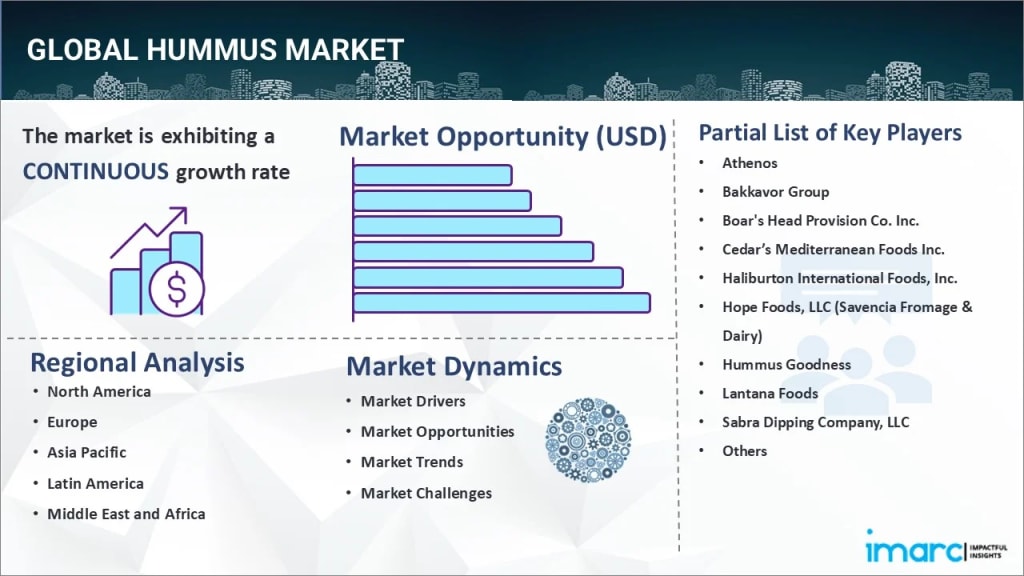
Growing consumer interest in plant-based eating, a sharper focus on clean-label nutrition, and the global spread of Mediterranean food culture are all converging to make hummus one of the most talked-about products in the packaged food space right now. According to IMARC Group’s latest research, the global hummus market size reached USD 4.7 Billion in 2025. Looking forward, IMARC Group estimates the market to reach USD 9.1 Billion by 2034, exhibiting a CAGR of 7.50% during 2026–2034. North America currently dominates the global market, driven by strong consumer demand for healthy, plant-based snacks and widespread adoption of Mediterranean-style diets across the region.
Hummus has evolved well beyond its Middle Eastern roots to become a mainstream pantry staple across North America, Europe, and increasingly Asia-Pacific. Supermarkets now stock dozens of variants — from classic to flavored options like roasted red pepper, sriracha, and organic hot honey — while foodservice operators from fast-casual chains to fine dining restaurants have integrated it into menus as a versatile dip, spread, and protein-rich accompaniment. The market’s expansion is backed by a strong foundation: chickpeas deliver roughly 15 grams of protein per cup, hummus registers a low glycemic index, and it serves as a natural substitute for calorie-dense condiments like mayonnaise and sour cream. These attributes are resonating with health-focused consumers at scale.
Hummus Market Growth Drivers:
Rising Health Consciousness and Lifestyle Disease Prevention
The link between diet and disease is pushing consumers toward nutrient-dense alternatives, and hummus checks nearly every box. The International Diabetes Federation estimates that over 537 million adults globally were living with diabetes as of 2021, a figure expected to climb to 643 million by 2030. This is driving real demand for low-glycemic, high-fiber foods. Hummus, with its plant-based protein profile and clean ingredient list, is increasingly seen as a smart swap for calorie-laden dips and spreads. Brands are responding with fortified versions featuring added probiotics, superfoods, and allergen-free formulations to capture this health-motivated buyer base.
Surging Demand for Plant-Based and Vegan Products
Veganism is no longer a niche movement — it’s a mainstream shift reshaping food purchasing behavior globally. In Mexico alone, roughly 20% of the 130 million population has moved away from animal-based foods. In the U.S., a 2020 Gallup poll found around 23% of consumers were already eating less meat than the year prior. Online retailer ShelfNow reported a 156% jump in vegetarian meal sales between 2020 and 2021. As a plant-based protein source with broad culinary versatility, hummus is a natural beneficiary of this trend, with brands like Amy’s Kitchen and Hope Foods actively expanding their vegan-certified product lines to meet growing demand.
Growing Popularity of Mediterranean and Middle Eastern Cuisines
The Mediterranean diet consistently ranks among the top dietary patterns recommended by nutritionists and government health bodies alike, and hummus is one of its most accessible entry points. In the U.S. alone, the market is projected to grow from USD 1.08 billion to USD 1.86 billion, with younger demographics leading the charge on globally inspired food exploration. This culinary curiosity is translating directly into sales, with supermarkets like Walmart carrying an expanding range of hummus variants. In April 2024, the launch of Hummus Republic in Stockton, California — a restaurant built around Mediterranean-inspired dishes — reflects how deeply hummus culture has embedded itself in American food retail and dining.
Hummus Market Trends:
Flavor Innovation and Premium Product Launches
Standard classic hummus is no longer enough to win shelf space or consumer loyalty. Brands are going bold with flavor-forward innovation to stand out. In March 2025, Little Sesame rolled out Green Goddess Hummus and Golden Garlic Hummus targeting premium, health-conscious buyers willing to pay more for distinctive profiles. Sabra has collaborated with Frank’s RedHot and Stubb’s to deliver spicy, flavor-layered options, while Fresh Cravings introduced Tajín Chili Lime and Dill Pickle varieties in late 2023. This premiumization trend is also reflected in pricing — flavored variants consistently command higher price points, making them an attractive margin play for both established brands and challenger labels.
Sustainable Packaging and Clean-Label Transparency
Sustainability isn’t just a brand talking point anymore — it’s a purchase driver. Consumers are scrutinizing packaging materials and ingredient sourcing more than ever, and hummus brands are responding in kind. In August 2024, Lantana Foods undertook a full rebrand with updated sustainable packaging, directly reflecting its commitment to environmental responsibility. In May 2023, Hope Foods launched an organic, non-GMO hummus lineup in packaging that prominently features its Plastic Neutral certification. India’s government has reinforced this through initiatives like the National Horticulture Mission, offering organic farming incentives that directly support clean-label ingredient supply chains that producers are increasingly tapping into.
Expanding Distribution Through Retail and E-Commerce Channels
Getting hummus in front of more buyers, more easily, is a clear strategic priority across the industry. Supermarkets and hypermarkets remain the dominant channel — they carry a broader assortment of brands and pack sizes than smaller outlets, suiting both everyday shoppers and those with specific dietary needs. In June 2021, Cedar’s Mediterranean Foods expanded its distribution to Amazon Fresh, bringing refrigerated hummus directly to online grocery buyers. Little Sesame recently secured USD 8 million in funding to build a 23,000-square-foot production facility in Maryland capable of producing 400,000 pounds of hummus weekly, a clear signal that demand growth is prompting serious supply-side investment to match.
Recent News and Developments in the Hummus Market
• March 2025: Little Sesame expanded its product portfolio with the launch of Green Goddess Hummus and Golden Garlic Hummus, tapping into growing consumer appetite for premium, flavor-forward variants beyond the classic category.
• August 2024: Lantana Foods completed a major rebrand, unveiling redesigned sustainable packaging across its hummus lineup to align with growing consumer preference for environmentally responsible products and to differentiate its bold, unconventional flavors on shelf.
• November 2023: Fresh Cravings launched two new hummus varieties — Tajín Chili Lime Hummus and Dill Pickle Hummus — bringing bold, cross-category flavor combinations into a traditionally flavor-conservative segment and capitalizing on the broader snacking industry’s shift toward adventurous taste profiles.
• August 2023: Sabra Dipping Company entered a co-branding collaboration with Frank’s RedHot and Stubb’s to develop enhanced flavored hummus products, signaling how the world’s largest hummus producer is leveraging established hot sauce brands to attract a broader, younger consumer base.
Note: If you require specific details, data, or insights that are not currently included in the scope of this report, we are happy to accommodate your request. As part of our customization service, we will gather and provide the additional information you need, tailored to your specific requirements. Please let us know your exact needs, and we will ensure the report is updated accordingly to meet your expectations.
About the Creator
Suhaira Yusuf
I specialize in Consumer Insights, focusing on transforming detailed market data into strategic business solutions that accelerate growth and improve customer engagement.
Keep reading
More stories from Suhaira Yusuf and writers in Futurism and other communities.
Microcontroller Market Trends: IoT Integration, Smart Devices & Forecast to 2034
Rapid expansion of IoT connectivity, the electrification of vehicles, and the relentless push toward smarter industrial automation are fundamentally reshaping demand for microcontrollers worldwide. These tiny chips now sit at the heart of billions of devices — from factory robots and EV powertrains to medical monitors and smart home hubs. According to IMARC Group's latest data, the global microcontroller market size reached USD 28.7 Billion in 2024. Looking forward, IMARC Group expects the market to reach USD 58.3 Billion by 2033, exhibiting a growth rate (CAGR) of 7.55% during 2025-2033. Asia Pacific currently dominates the market with the largest revenue share, fueled by high-volume electronics manufacturing hubs across China, Japan, South Korea, and Taiwan.
By Suhaira Yusuf2 days ago in Futurism
Adhesion Promoter Market Trends: Sustainable Coatings, High-Performance Materials & Industry Forecast to 2034
Optimizing bond strength and surface durability is becoming a central focus for industrial manufacturers as they transition toward advanced composites and high-performance coatings. According to IMARC Group’s latest data, the global adhesion promoter market size was valued at USD 4.44 Billion in 2025. Looking forward, IMARC Group estimates the market to reach USD 6.34 Billion by 2034, exhibiting a CAGR of 4.03% from 2026-2034. Asia Pacific currently dominates the market, holding a significant market share of over 45.3% in 2025.
By Andrew Sullivan3 days ago in Futurism



Comments
There are no comments for this story
Be the first to respond and start the conversation.