
Airburst vs Ground Burst: How Nuclear Bomb Detonations Change Destruction, Fallout, and Survival
Why nuclear weapons can explode in the air or on the ground—and how each method dramatically changes blast damage, radiation, and long-term environmental effects
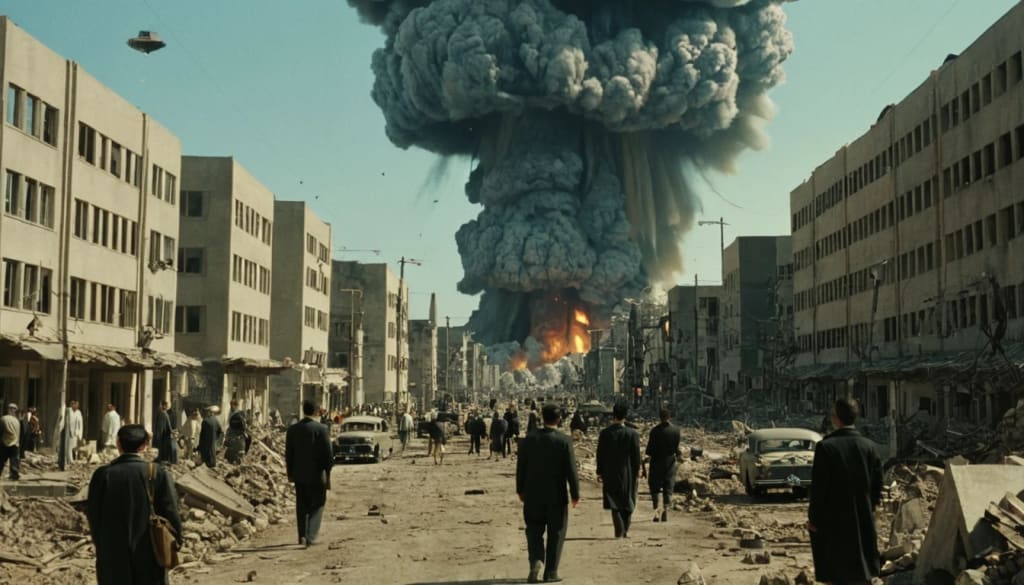
When people imagine a nuclear explosion, they often picture the enormous mushroom cloud rising over a city. What many do not realize is that nuclear weapons can be detonated in different ways depending on the objective of the attack. The altitude of the explosion—whether the bomb explodes high above the ground or directly on the surface—changes how the energy spreads, how much destruction occurs, and how much radioactive contamination follows. These two main methods are known as airbursts and ground bursts, and the differences between them are profound.
A nuclear airburst occurs when a weapon explodes hundreds of meters above the surface rather than on it. The height is carefully chosen so that the blast wave spreads outward in every direction and reflects off the ground, amplifying the destructive pressure. Military planners discovered early in the nuclear age that detonating a bomb above the target greatly increases the area affected by the shockwave. Instead of wasting energy digging into the soil, the explosion spreads its force across the air, flattening buildings and structures over a much larger region.
The bombs used during the Atomic bombings of Hiroshima and Nagasaki were detonated as airbursts for exactly this reason. The Hiroshima bomb exploded roughly six hundred meters above the city. At that height, the blast wave expanded downward and outward, reflecting from the ground and reinforcing itself. This reflection created an intense pressure zone that destroyed large portions of the city’s buildings and infrastructure. By exploding above the ground rather than on it, the bomb produced the maximum possible destruction across an urban area.
Airbursts also spread intense thermal radiation over a wide region. Within a fraction of a second after the explosion, a brilliant flash of light and heat radiates outward from the fireball. This thermal pulse can ignite fires kilometers away from the detonation point. In cities filled with wood, paper, fuel, and dense housing, thousands of small fires can begin almost simultaneously. As these fires grow and merge, they may create a firestorm, a powerful inferno in which rising hot air pulls oxygen inward like a giant furnace. Entire neighborhoods can burn in such conditions, even if they were not destroyed directly by the blast.
Another characteristic of airbursts is that they produce relatively less radioactive fallout compared with ground explosions. Because the fireball does not touch the surface, it does not pull large quantities of soil, concrete, and debris into the radioactive cloud. Most of the radioactive particles remain high in the atmosphere and disperse gradually over large distances. While radiation still presents serious health risks, the immediate local contamination on the ground is significantly lower than it would be after a surface explosion.
Ground bursts, by contrast, occur when a nuclear weapon detonates directly on the surface or slightly underground. In this case the fireball expands until it physically touches the ground. When that happens, enormous amounts of soil, rock, building material, and dust are instantly vaporized and drawn upward into the mushroom cloud. These materials become coated with radioactive particles generated during the nuclear reaction. As the cloud rises and cools, the contaminated debris begins to fall back to Earth as radioactive fallout.
The consequences of this process are far more severe in terms of long-term contamination. Fallout particles may drift downwind for hundreds of kilometers, settling on fields, rivers, towns, and forests. Some particles fall within hours, while finer dust can travel across entire regions before settling. The radioactive material can contaminate soil and water supplies, exposing people to dangerous levels of radiation long after the explosion itself has ended.
For this reason, ground bursts are typically associated with extremely heavy fallout zones. Anyone caught downwind without adequate shelter could receive significant radiation exposure. Radioactive particles can settle on skin, clothing, food, and water sources, making survival difficult without careful protection and decontamination measures.
Despite producing more contamination, ground bursts are sometimes chosen for specific military targets. Certain facilities, such as underground bunkers, hardened command centers, and missile silos, are designed to withstand ordinary blast waves. Destroying these structures requires transmitting a powerful shockwave through the ground itself. A nuclear explosion at or near the surface sends enormous seismic forces through the soil and rock, potentially crushing buried structures that might survive an airburst.
Another difference between the two detonation types involves how energy is distributed. In an airburst, nearly all of the explosive energy spreads through the air as heat and blast pressure. In a ground burst, a significant portion of the energy is absorbed by the ground, where it excavates a massive crater. As a result, the blast radius above the surface may actually be smaller than that of an airburst of the same yield. The explosion sacrifices some outward destructive power in order to damage the ground itself.
The crater produced by a ground burst can be enormous. Large nuclear test explosions conducted during the Cold War created craters hundreds of meters wide and dozens of meters deep. These scars in the landscape demonstrate how much energy can be directed into the Earth when the explosion occurs at ground level.
From a strategic perspective, the two detonation methods serve very different purposes. Airbursts are designed to maximize destruction over wide areas, making them particularly devastating for cities and industrial regions. Ground bursts are intended to destroy hardened military targets and infrastructure that cannot easily be damaged by air pressure alone.
In a large-scale nuclear conflict, both types of detonations would likely be used. Cities might be struck with airbursts to create maximum blast damage and fires, while missile bases or underground facilities could be targeted with ground bursts to eliminate strategic weapons. The combination of these methods would produce not only widespread destruction but also severe radioactive contamination across large regions.
Understanding the difference between airbursts and ground bursts reveals how the physics of nuclear weapons shapes their effects on the world. A few hundred meters of altitude can determine whether an explosion spreads destruction across a city or spreads radioactive dust across entire landscapes. It is a reminder that the impact of nuclear weapons depends not only on their size but also on how and where they are used.
The science behind these detonations has been studied for decades, not only by military planners but also by scientists concerned with the environmental and humanitarian consequences of nuclear war. Their research continues to show that even a limited number of nuclear explosions could have profound effects on human societies, ecosystems, and the global climate.
The difference between an airburst and a ground burst may seem like a technical detail, but in reality it represents two very different paths of destruction. One maximizes immediate blast damage and fire, while the other spreads radioactive contamination across the land. Both demonstrate the extraordinary power of nuclear weapons and the long shadows they cast over the modern world.
About the Creator
Algieba
Curious observer of the world, exploring the latest ideas, trends, and stories that shape our lives. A thoughtful writer who seeks to make sense of complex topics and share insights that inform, inspire, and engage readers.
The Mughal Princess Who Became One of the Wealthiest Women in History
Among the many remarkable women of the Mughal Empire, Jahanara Begum stands out as one of the most powerful and wealthy princesses in South Asian history. Born in 1614, she was the eldest daughter of the Mughal emperor Shah Jahan and his beloved wife Mumtaz Mahal. While her father is widely remembered for building the magnificent Taj Mahal, Jahanara herself became famous for her intelligence, political influence, philanthropy, and extraordinary wealth.
By Irshad Abbasi about 13 hours ago in History
Top tipple tricks
Been thinking a lot about drinking, lately. Not least because of a recent episode of over-indulgence and the inevitable after effects. Some readers may recall the earlier articles I wrote about beating the booze. Here I set out an experiment in techniques for cutting down on my alcohol intake. The experiment was successful, the techniques worked, and I have armed myself with an arsenal of weapons in the war against the demon drink. I have yet to fire the first round however. It's all a question of timing (perhaps procrastination).
By Raymond G. Taylor4 days ago in Psyche




Comments
There are no comments for this story
Be the first to respond and start the conversation.