
Ancient Super Weapons That Changed Warfare Forever
From Archimedes’ Deadly Machines to the Mysterious Greek Fire, The Ingenious War Tech of the Ancient World

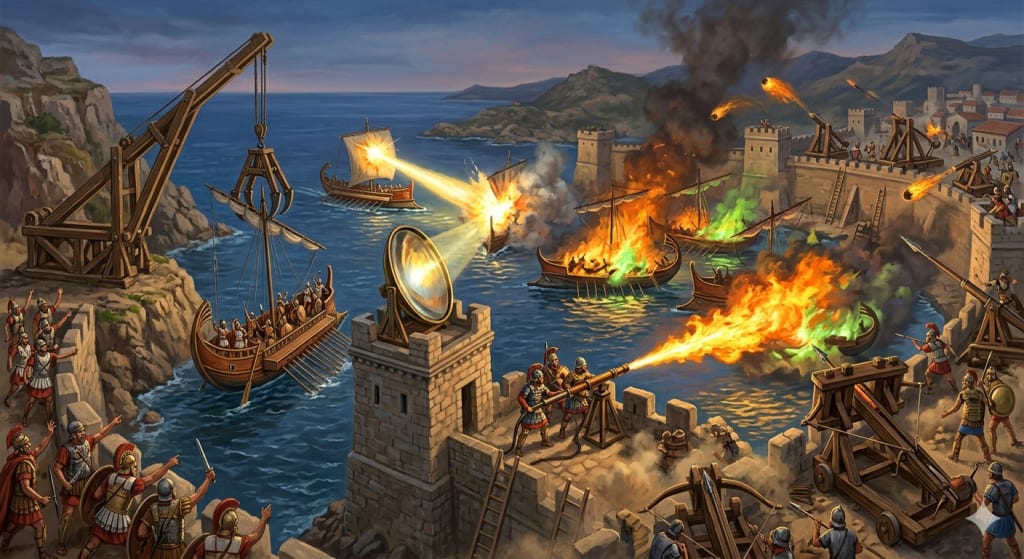
Throughout recorded history, warfare has shaped civilizations. Long before drones, missiles, and cyber warfare, ancient societies were already engineering terrifying and brilliant machines designed to dominate the battlefield.
When we think of ancient wars, we often imagine swords and shields. But the truth? Some of these civilizations developed what could easily be called “super weapons” of their time, machines so advanced and devastating that they changed the course of history.
Let’s explore five of the most incredible ancient super weapons ever created.
1. The Claw of Archimedes - The Ship-Lifting Terror
During the Second Punic War (214 BC), the Roman Republic attacked the city of Syracuse with a massive fleet. But they weren’t prepared for the genius of Archimedes.
The Claw of Archimedes, sometimes called the “Iron Hand,” was essentially a giant crane with a grappling hook mounted on Syracuse’s sea walls. When Roman ships came too close, the device would:
- Grab the ship’s hull.
- Lift it partially out of the water.
- Suddenly drop it, causing capsizing or structural damage.
Ancient historians credit this weapon with causing heavy Roman losses and creating total chaos among attacking forces.
Imagine sailing at night… and suddenly your warship is lifted into the air.
2. The Helepolis - “Taker of Cities.”
The name Helepolis literally translates to “Taker of Cities.” And it earned that title.
This massive movable siege tower stood roughly 130 feet tall and 65 feet wide. Built during the Hellenistic period and improved by Demetrius I of Macedon, it was used during the Siege of Rhodes.
Here’s what made it extraordinary:
- Weighed around 6 tons
- Required 3,400 men working in shifts to move
- Mounted on enormous wheels
- Allowed soldiers to attack city walls from above
Although the siege ultimately failed, the abandoned war machines were later melted down by the Rhodians to help construct the legendary Colossus of Rhodes, one of the Seven Wonders of the Ancient World.
Talk about turning weapons into art.
3. The Hwacha - The Early Rocket Launcher
Centuries before modern rocket systems, Korea developed something astonishing: the Hwacha.
This two-wheeled rocket launcher could fire up to 100–200 gunpowder-propelled arrows simultaneously. Yes, a medieval rocket battery.
It played a critical role during the Japanese invasions of Korea in the late 16th century, particularly at the Battle of Haengju (1593), where:
- Around 3,000 Korean defenders
- Held off approximately 30,000 Japanese soldiers
Much of that victory is credited to roughly 40 Hwacha units.
In today’s terms? It was psychological warfare as much as physical destruction.
4. The Archimedes’ heat ray - The Solar Death Ray
Another invention attributed to Archimedes is the infamous “death ray.”
Ancient accounts claim that during the Siege of Syracuse, Archimedes used:
- Highly polished mirrors
- Positioned along city walls
- To focus sunlight onto Roman ships
The concentrated heat allegedly caused ships to burst into flames.
For centuries, historians debated whether this was myth or reality. Even the TV show MythBusters attempted to recreate it, and failed to produce convincing battlefield results.
Yet other modern experiments have shown partial success under controlled conditions.
Was it practical in real combat? That remains controversial.
But the idea alone shows the astonishing scientific imagination of the ancient world.
5. Greek fire - The Flame That Burned on Water
Perhaps the most terrifying ancient weapon of all: Greek Fire.
Developed by the Byzantine Empire in the 7th century AD, this was a highly flammable liquid weapon used primarily in naval warfare.
Its terrifying properties:
- Sprayed through tubes like a flamethrower
- Stuck to surfaces
- Burned even on water
- Extremely difficult to extinguish
The formula was a closely guarded state secret and was eventually lost after the empire’s fall.
Historians believe it likely contained substances such as:
- Crude oil
- Naphtha
- Sulfur
Greek Fire allowed the Byzantines to dominate naval battles for centuries. But it was also dangerous; mishandling it could result in catastrophic friendly casualties.
A weapon powerful enough to change wars, yet dangerous enough to destroy its own users.
Why Ancient Super Weapons Still Matter Today
It’s easy to assume technological innovation is a modern phenomenon. But these examples prove otherwise.
The ancient world demonstrated:
- Engineering brilliance
- Tactical innovation
- Ruthless battlefield creativity
- Advanced understanding of physics and chemistry
Many principles behind these weapons, such as leverage, incendiary compounds, and projectile systems, laid the groundwork for modern military engineering.
The tools may have changed, but the human drive to innovate in warfare has remained constant.
Final Thoughts
The ancient world was far from primitive. In fact, it was shockingly inventive, sometimes disturbingly so.
From ship-lifting claws to rockets and liquid fire that burned on water, these ancient super weapons remind us that human genius has always walked hand-in-hand with human conflict.
So here’s a question for you:
Which of these ancient weapons do you think was the most destructive, or the most brilliant?
.
.
.
.
.
.
.
.
.
.
Ancient super weapons, ancient warfare technology, Archimedes inventions, Greek Fire history, Hwacha rocket launcher, Helepolis siege tower, Byzantine weapons, Second Punic War weapons, ancient military engineering.
About the Creator
Areeba Umair
Writing stories that blend fiction and history, exploring the past with a touch of imagination.
Keep reading
More stories from Areeba Umair and writers in History and other communities.
12 American Flag Designs That Almost Changed History
The American flag is one of history’s most iconic symbols. Its red, white, and blue stripes, along with fifty stars, instantly represent freedom, democracy, and national pride. But did you know that the flag we all recognize today didn’t become official until 1960?
By Areeba Umair3 days ago in History
Ancient Roman Secrets: What Their Monuments Teach Us About Sustainable Construction
Across Europe and the Mediterranean, the remains of ancient Roman structures continue to amaze architects, engineers, and historians alike. Massive aqueducts still stretch across valleys, amphitheaters remain standing after centuries of earthquakes and wars, and the iconic Pantheon in Rome still boasts the world’s largest unreinforced concrete dome. These remarkable structures are more than just archaeological treasures; they hold important lessons for modern construction. Hidden within these monuments is a set of engineering secrets that could help today’s builders create stronger, longer-lasting, and more sustainable structures.
By Irshad Abbasi 6 days ago in History
Sometimes It's Like That and That'sThe Way It Is
It was the late 1960s, and ten-year-old Gloria Coleman was standing with her grandmother on the side of the highway waiting for the bus. As the Greyhound pulled up, it seemed monstrous and intimidating. Grandma Elizabeth grabbed Gloria's hand, holding it tightly as they boarded.
By Cheryl E Preston3 days ago in Fiction


Comments
There are no comments for this story
Be the first to respond and start the conversation.