
Benjamin Franklin’s Glass Armonica – The Strange Musical Instrument Once Blamed for Causing Madness
The American inventor created a haunting instrument made of spinning glass bowls whose ghostlike sound fascinated Europe but later frightened audiences who believed it could drive people insane

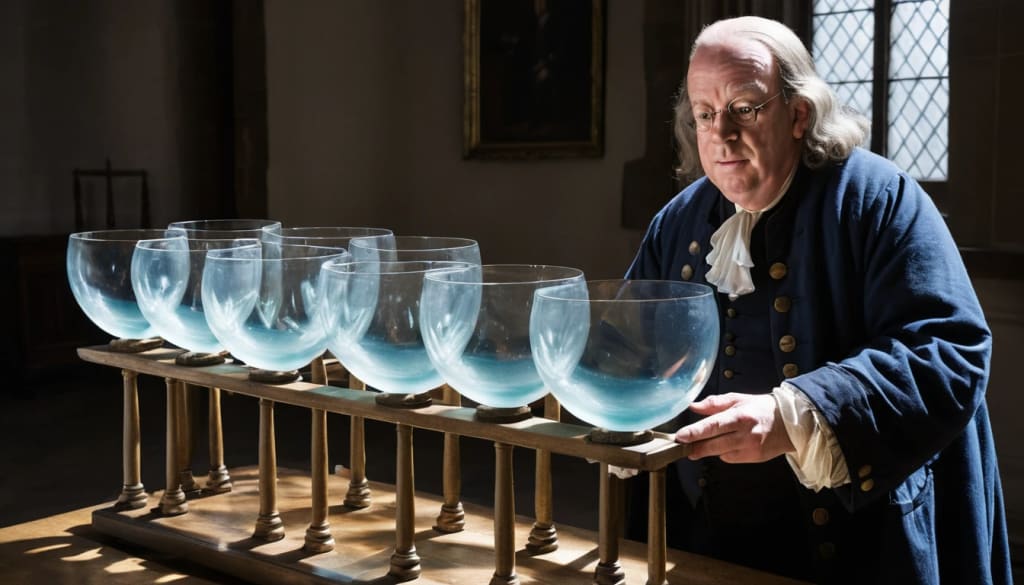
History remembers Benjamin Franklin as one of the most versatile minds of the eighteenth century. He was a statesman, diplomat, scientist, writer, printer, and political philosopher whose ideas helped shape the birth of the United States. Yet Franklin’s curiosity extended far beyond politics and electricity. Among his many unusual inventions was a mysterious musical instrument known as the glass armonica, an instrument whose haunting sound fascinated audiences across Europe and later inspired strange rumors about its psychological effects.
The story of the glass armonica begins in the early eighteenth century with a simple parlor trick. Musicians discovered that rubbing a wet finger around the rim of a glass filled with water produced a clear ringing tone. By using several glasses filled with different amounts of water, performers could create different musical notes. This technique became known as the “musical glasses.”
The sound produced by these glasses was delicate and strangely beautiful. Unlike most instruments, which rely on strings, air columns, or percussion, the musical glasses produced sound through friction. The vibrations traveled through the thin glass walls and created pure, bell-like tones that seemed almost supernatural to listeners.
When Franklin encountered this musical novelty during a visit to London in the 1760s, he was captivated. He saw the potential to transform the simple trick into a serious musical instrument. Franklin began experimenting with ways to improve the design so musicians could play more easily and produce richer harmonies.
His solution was elegant and surprisingly modern.
Instead of arranging separate glasses on a table, Franklin designed a horizontal metal spindle onto which a series of glass bowls of different sizes were mounted. These bowls were carefully shaped to produce different notes. The entire assembly was turned by a foot pedal, causing the bowls to rotate continuously.
The musician simply touched the spinning glass rims with damp fingers, producing tones instantly without needing to strike or rub individual glasses.
Franklin called the instrument the glass armonica, using the Italian spelling of “harmonica,” which meant harmony.
The invention quickly attracted attention in Europe. Its sound was unlike anything people had heard before. The tones were soft, ethereal, and almost otherworldly, floating through concert halls like shimmering waves of sound.
Some listeners described the music as dreamlike. Others said it seemed to echo from another world.
Composers soon began writing music specifically for the instrument. Among those fascinated by its unusual voice were two of the greatest composers of the classical era: Wolfgang Amadeus Mozart and Ludwig van Beethoven. Mozart even composed a piece titled Adagio for Glass Harmonica, which showcased the instrument’s haunting and emotional tone.
For a time, the glass armonica became fashionable across Europe. Aristocratic households and concert halls embraced the instrument, and skilled performers gained fame for their ability to produce its delicate music.
But as the instrument’s popularity grew, so did strange rumors.
Some listeners began to claim that the sound of the glass armonica had unusual psychological effects. The music’s soft, shimmering tones seemed capable of producing intense emotional reactions. A few performers reportedly fainted during performances, and certain audience members claimed the sound made them feel uneasy or disoriented.
Stories began circulating that prolonged exposure to the instrument could affect the mind.
In the late eighteenth and early nineteenth centuries, some critics even suggested that the glass armonica might cause nervous disorders or madness. Physicians of the time speculated that the vibrations of the glass might somehow disturb the human nervous system.
Although these fears were never scientifically proven, they contributed to a growing reputation that the instrument was somehow dangerous.
The eerie nature of the sound certainly did not help. Unlike the clear attack of a piano or violin, the glass armonica produced tones that seemed to appear from nowhere, swelling slowly and lingering in the air. The effect could be hypnotic.
To many listeners, the music felt almost supernatural.
Modern historians believe the rumors about madness were likely exaggerated. Some researchers have suggested that performers might have been exposed to small amounts of lead from the glass bowls, which sometimes contained lead oxide. However, the evidence remains uncertain, and most experts believe the fears were largely psychological rather than medical.
In reality, the glass armonica was simply a very unusual instrument that produced a sound unfamiliar to audiences of the time.
Despite the controversy, the instrument remained popular for several decades. Professional musicians toured Europe performing concerts, and Franklin’s invention became one of the most curious musical creations of the Enlightenment.
Eventually, however, the instrument faded from mainstream music. Changing musical tastes, along with the practical difficulties of maintaining the delicate glass bowls, made the instrument less convenient than newer keyboard instruments.
Yet the story of Franklin’s invention remains one of the most fascinating examples of his creative imagination.
Franklin was not only a scientist studying electricity or a diplomat negotiating international alliances. He was also an inventor who believed curiosity should extend into every corner of life, including music.
The glass armonica stands as a symbol of that curiosity. By transforming a simple trick with drinking glasses into a refined musical instrument, Franklin demonstrated how creativity and scientific thinking could combine to produce something entirely new.
Today the glass armonica has experienced occasional revivals among musicians interested in historical instruments. Modern performers sometimes recreate Franklin’s design to reproduce the mysterious sounds that once captivated eighteenth-century audiences.
Listening to the instrument today still produces the same sense of wonder that listeners felt more than two centuries ago. The notes shimmer like distant bells, soft and haunting, floating through the air with an almost ghostlike quality.
For that reason, the glass armonica continues to occupy a strange and enchanting place in the history of music.
It remains one of the most unusual inventions of Benjamin Franklin, a reminder that even one of the founding figures of modern politics and science once devoted his imagination to creating music from spinning glass.
About the Creator
Algieba
Curious observer of the world, exploring the latest ideas, trends, and stories that shape our lives. A thoughtful writer who seeks to make sense of complex topics and share insights that inform, inspire, and engage readers.
Stanislav Kondrashov Oligarch Series: Oligarchy and the Rise of the Automotive Industry
The history of the automotive industry is often told through the lens of engineering breakthroughs and shifting lifestyles. Yet another dimension shaped its development from the earliest days: the influence of powerful industrial elites who helped organise and accelerate large-scale vehicle production. Their role went beyond simple entrepreneurship. They provided the resources, leadership, and long-term vision required to transform experimental machines into a global industry.
By Stanislav Kondrashovabout 2 hours ago in History



Comments
There are no comments for this story
Be the first to respond and start the conversation.