
Hidden Void Discovered Inside the Great Pyramid of Khufu
Scientists uncover a massive mysterious chamber inside Egypt’s most famous pyramid using advanced scanning technology.

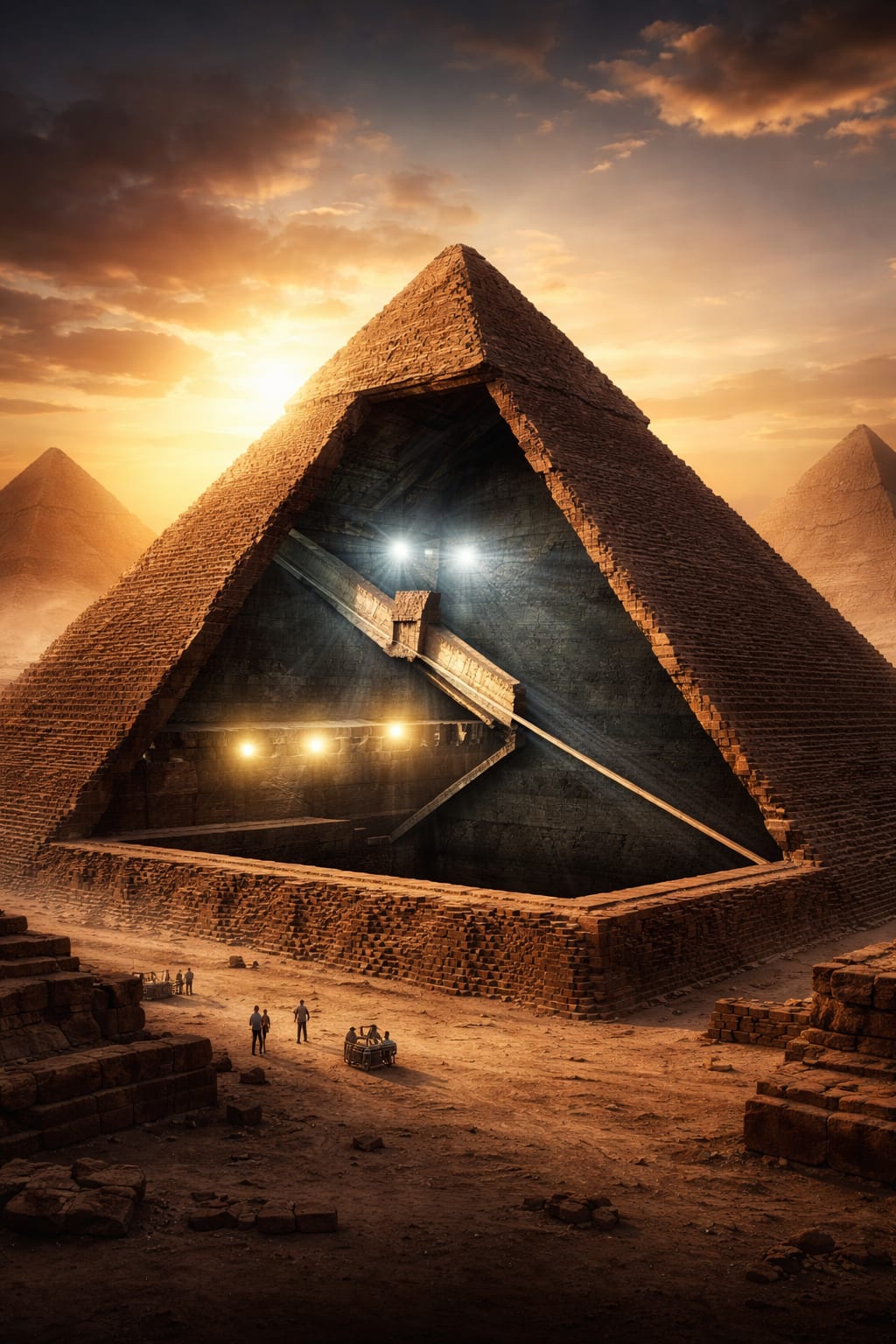
For centuries, the Great Pyramid of Khufu in Egypt has fascinated historians, archaeologists, and travelers from around the world. Built more than 4,500 years ago during the reign of Pharaoh Khufu, the pyramid is the largest and oldest of the three pyramids of Giza. Despite decades of research and exploration, many secrets of this ancient structure remain hidden. Recently, scientists revealed one of the most intriguing discoveries yet — a large hidden void inside the pyramid that had remained unknown for thousands of years.
The discovery was announced by an international team of researchers working under a project known as “ScanPyramids.” Using advanced technology called muon radiography, scientists were able to scan the internal structure of the pyramid without physically damaging it. Muons are tiny particles that constantly rain down on Earth from space. These particles can penetrate solid materials, allowing scientists to study the interior of massive structures such as pyramids.
By analyzing how muons passed through the stone blocks of the pyramid, researchers detected a large empty space located above the Grand Gallery, one of the main corridors inside the pyramid. According to the scientists, this mysterious void is at least 30 meters (about 100 feet) long, making it one of the largest hidden spaces ever found inside the structure.
The discovery has sparked excitement and curiosity across the world. Although archaeologists have long believed that there might be undiscovered chambers inside the pyramid, the scale of this newly detected void surprised many experts. Until now, the known internal structures of the pyramid included the King’s Chamber, the Queen’s Chamber, and the Grand Gallery. The newly discovered void does not appear to connect directly to any of these known rooms.
Researchers are still uncertain about the exact purpose of this hidden space. Some experts suggest it may have been constructed to reduce the weight and pressure placed on the Grand Gallery below. In ancient Egyptian architecture, builders sometimes created empty spaces within large structures to prevent structural collapse. If this theory is correct, the void may have been designed as an engineering solution rather than a secret chamber.
However, other scholars believe the void could hold more significant secrets. Some archaeologists speculate that it may contain hidden corridors or chambers that have not yet been explored. Because the pyramid was built as a tomb for Pharaoh Khufu, some researchers wonder whether undiscovered burial spaces or ritual areas could exist inside.
The Great Pyramid has been studied for centuries, but exploring its interior has always been extremely difficult. The massive limestone blocks that make up the pyramid weigh several tons each, and drilling or digging into the structure could damage this priceless historical monument. That is why non-invasive technologies like muon scanning have become so important in modern archaeology.
The ScanPyramids project began in 2015 with the goal of studying the internal structure of Egypt’s pyramids using advanced scientific techniques. In addition to muon detection, the team has used infrared thermography and 3D reconstruction to search for hidden anomalies inside the ancient monuments. The discovery of the large void inside the Great Pyramid is considered one of the most significant findings of the project.
Egyptian authorities and researchers are now discussing possible ways to investigate the space further. One idea is to send tiny robotic probes equipped with cameras through small openings to explore the void without harming the pyramid. Such technology has been used successfully in other archaeological sites where access is limited.
The discovery has also renewed global interest in ancient Egyptian engineering. The Great Pyramid was constructed with remarkable precision using millions of stone blocks, and historians still debate exactly how ancient builders managed to complete such a massive project thousands of years ago without modern machinery.
For many people, the pyramid represents one of the greatest architectural achievements in human history. The newly discovered void reminds researchers that even after centuries of exploration, the ancient monument still holds mysteries waiting to be uncovered.
As technology continues to improve, scientists hope that more secrets hidden within the Great Pyramid may eventually be revealed. Whether the newly discovered void turns out to be a simple structural feature or a hidden chamber with historical significance, it has already deepened humanity’s fascination with one of the world’s most iconic monuments.
The Great Pyramid of Khufu has stood in the Egyptian desert for more than four millennia. Now, thanks to modern science, it is once again capturing the world’s imagination by revealing a mystery that remained hidden for thousands of years.
About the Creator
Irshad Abbasi
Ali ibn Abi Talib (RA) said 📚
“Knowledge is better than wealth, because knowledge protects you, while you have to protect wealth.
Keep reading
More stories from Irshad Abbasi and writers in History and other communities.
Ancient Egyptian Tomb Unearthed: 3,000-Year-Old Remains of Four Children Discovered
In a remarkable archaeological discovery in Egypt, researchers have uncovered the mummified remains of four children dating back nearly 3,000 years. The find, located in the southern region of Luxor, offers a rare glimpse into the lives, deaths, and funerary customs of young Egyptians during the New Kingdom period.
By Irshad Abbasi 3 days ago in History
The Year 1986 in Review: Fun Facts, Trivia, and Historic Highlights
This quick read is a collection of fun facts, trivia, and historical events from the year 1986. Discover the year’s top news stories, most influential people, sports trivia, grocery prices, and much more.
By Gregory DeVictor2 days ago in History


Comments
There are no comments for this story
Be the first to respond and start the conversation.