
Saddam Hussein’s Fascination with the Ruins of Babylon
How Iraq’s former leader attempted to revive the glory of ancient Mesopotamia by rebuilding parts of the legendary city of Babylon.

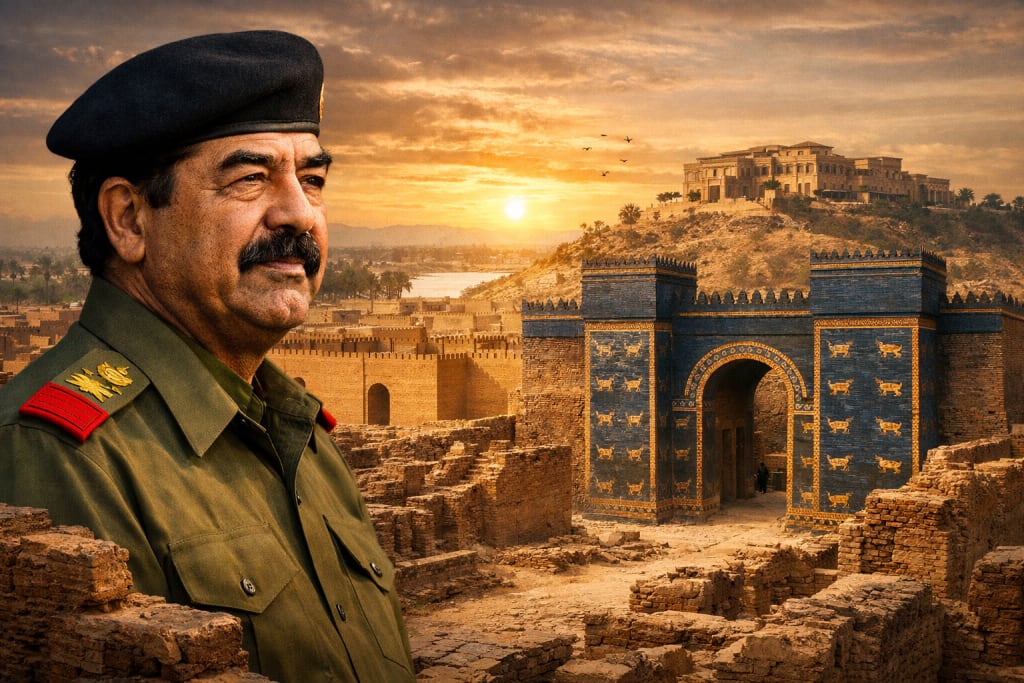
The ancient city of Babylon has long captured the imagination of historians, archaeologists, and travelers. Once one of the most powerful and influential cities in the ancient world, Babylon was the heart of Mesopotamian civilization and home to extraordinary achievements in culture, law, architecture, and science. Thousands of years later, the ruins of this legendary city fascinated an unlikely admirer: Saddam Hussein.
During his rule over Iraq from 1979 to 2003, Saddam Hussein developed a deep interest in the history of ancient Mesopotamia, particularly the glory of Babylon. He saw the city not only as an archaeological treasure but also as a symbol of Iraqi pride and power. By associating himself with ancient kings, Saddam hoped to strengthen his image as a strong leader and revive a sense of national identity rooted in Iraq’s ancient past.
Babylon was originally founded thousands of years ago along the banks of the Euphrates River. At its peak, especially under the rule of the famous king Nebuchadnezzar II in the 6th century BCE, the city became one of the most magnificent urban centers of the ancient world. It featured impressive temples, massive defensive walls, and monumental gates such as the famous Ishtar Gate, decorated with brilliant blue glazed bricks and images of mythical animals.
Saddam Hussein admired Nebuchadnezzar II and often compared himself to the ancient king. He believed that just as Nebuchadnezzar had built a powerful empire, modern Iraq could once again become a dominant force in the region. To reflect this vision, Saddam launched a controversial project in the 1980s to rebuild parts of the ancient ruins of Babylon.
Instead of focusing purely on archaeological preservation, Saddam ordered the reconstruction of several ancient structures using modern bricks. What made this project particularly unusual was that many of these bricks were stamped with an inscription praising Saddam himself. The inscription reportedly read: “In the era of Saddam Hussein, the protector of Iraq, who rebuilt civilization.” This mirrored the practice of ancient Mesopotamian kings, who often marked bricks with their names to show their contributions to building projects.
One of the most ambitious aspects of Saddam’s Babylon project was the construction of a large palace overlooking the ruins. The palace, built on a hill above the archaeological site, symbolized his desire to link his rule with the grandeur of ancient Babylonian kings. From the palace terraces, one could look down at the reconstructed walls and courtyards of the ancient city.
However, Saddam’s reconstruction efforts were widely criticized by archaeologists and historians around the world. Many experts argued that rebuilding ancient ruins with modern materials damaged the authenticity of the site. Archaeologists generally prefer careful preservation and excavation rather than large-scale reconstruction, especially when historical details are uncertain.
Despite the criticism, Saddam continued promoting Babylon as a symbol of Iraqi heritage. In the late 1980s, he even organized the Babylon International Festival, which featured music, theater, poetry, and cultural performances. The festival was intended to celebrate Iraqi culture while highlighting the historical significance of Babylon.
Following the 2003 invasion of Iraq and the fall of Saddam Hussein’s government, the site of Babylon faced new challenges. At one point, foreign military forces established a base near the ruins, which caused additional damage to the fragile archaeological remains. Over time, however, efforts have been made to restore and protect the site.
In 2019, Babylon achieved a major milestone when UNESCO officially designated it as a Babylon World Heritage Site. This recognition highlighted the city’s extraordinary historical value and encouraged international cooperation to preserve the ruins for future generations.
Today, the story of Saddam Hussein and Babylon remains a fascinating chapter in the history of archaeology and politics. While his rebuilding projects were controversial, they reflected a powerful desire to connect modern Iraq with its ancient roots. Babylon continues to stand as a reminder of one of humanity’s earliest civilizations—and of how history can be used by leaders to shape national identity and legacy.
About the Creator
Irshad Abbasi
Ali ibn Abi Talib (RA) said 📚
“Knowledge is better than wealth, because knowledge protects you, while you have to protect wealth.
Keep reading
More stories from Irshad Abbasi and writers in History and other communities.
Strange Sea Creatures Wash Ashore in Texas After Powerful Storm
After a powerful coastal storm swept across the Gulf Coast of Texas, residents walking along the beaches made an unusual discovery: strange and rarely seen marine creatures scattered along the shoreline. The unexpected appearance of these mysterious sea animals quickly caught the attention of locals, tourists, and marine scientists alike.
By Irshad Abbasi a day ago in History
The Year 1916 in Review: Fun Facts, Trivia, and Historic Highlights
This quick read is a collection of fun facts, trivia, and historic events from the year 1916. Discover the year’s top news stories, most influential people, sports trivia, grocery prices, entertainment news, and much more.
By Gregory DeVictor4 days ago in History
Writing To Succeed
If you want to find something that will help readers find your writing, possibly expand your audience, and maybe even get you noticed for other things, then you’re not alone. But how can you get it done in a world full of want-to-be writers? Look less at what you’re writing now, and more at what other writers have used to boost their views and reads.
By Jason Ray Morton 5 days ago in Writers




Comments
There are no comments for this story
Be the first to respond and start the conversation.