
The ‘Lone Warrior’ of Freedom Who Declared an Independent Pashtun State
A story of resistance, tribal defiance, and the controversial dream of “Pashtunistan” in the turbulent years surrounding the birth of Pakistan.

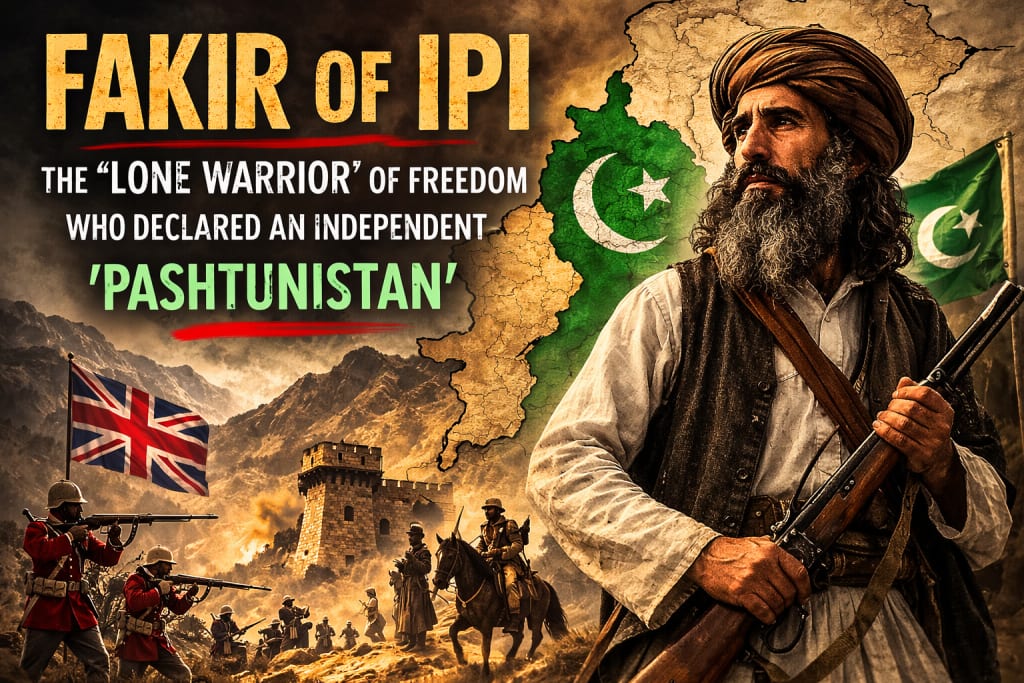
The history of the subcontinent’s struggle against colonial rule is filled with famous leaders, mass movements, and political negotiations. Yet hidden within these narratives are figures whose stories remain lesser known but deeply fascinating. One such personality was Fakir of Ipi, a tribal leader from the rugged mountains of Waziristan who spent decades resisting British authority and later opposed the creation of Pakistan. Known to many as the “lone warrior of freedom,” Fakir of Ipi became a symbol of tribal resistance and a controversial advocate for an independent Pashtun homeland.
Fakir of Ipi, whose real name was Haji Mirzali Khan, was born around 1897 in the village of Ipi in North Waziristan, a region that has historically been difficult for outside powers to control. The tribal belt along the Afghan frontier was fiercely independent, governed more by tribal customs and loyalties than by any centralized authority. This environment shaped Mirzali Khan’s worldview and leadership style. He grew up deeply religious and eventually became a spiritual figure among local tribes, earning the title “Fakir.”
His prominence rose dramatically in the 1930s when he began openly challenging British colonial rule in the region. A key turning point came in 1936, following a controversial legal case involving the alleged conversion and marriage of a Hindu girl to a Muslim man. Many tribes saw the British decision in the case as interference in local customs and Islamic matters. Fakir of Ipi used the incident to mobilize tribes against the colonial administration, launching what would become a long-running insurgency in Waziristan.
Over the next decade, Fakir of Ipi led guerrilla resistance against British forces. From mountain hideouts and remote tribal territories, his followers carried out raids and attacks, making it extremely difficult for the British to establish stable control. At one point, the British deployed tens of thousands of troops in Waziristan to suppress the rebellion, yet they struggled to capture or neutralize him. The rugged terrain, combined with tribal loyalties and the Fakir’s reputation as a spiritual leader, helped him evade colonial authorities.
To many local tribesmen, he represented resistance against foreign rule and interference. His supporters viewed him as a defender of tribal autonomy and Islamic values. British officials, however, saw him as a persistent insurgent who destabilized the frontier region. This dual image would follow him throughout his life.
The end of British colonial rule in 1947 created a new political reality in South Asia with the emergence of two independent states: India and Pakistan. While many Muslim leaders supported the creation of Pakistan, not everyone in the frontier regions agreed with the new arrangement. Fakir of Ipi was among those who rejected it.
Instead of recognizing Pakistan, he reportedly declared support for an independent Pashtunistan, a proposed homeland for the Pashtun people that would unite Pashtun areas across the borderlands. This idea was also supported by some Pashtun nationalist leaders who believed the new borders did not reflect the aspirations of the Pashtun population.
Fakir of Ipi’s opposition to Pakistan placed him in a complicated position. Unlike his earlier struggle against the British, which had been framed as anti-colonial resistance, his continued defiance now challenged the authority of a newly formed Muslim state. The government of Pakistan attempted to bring stability to the frontier region, but Fakir of Ipi remained a symbol of dissent in parts of Waziristan.
Throughout the late 1940s and 1950s, he continued to live in the tribal areas along the Pakistan-Afghanistan border. Though his armed movement gradually lost momentum, he maintained influence among certain tribal groups and remained committed to his vision of Pashtun autonomy. Afghan authorities were sometimes accused by Pakistan of supporting Pashtunistan activism, which added further complexity to regional politics.
Despite the controversies surrounding his political stance, Fakir of Ipi remains an intriguing historical figure. For some historians, he represents a stubborn tribal leader who resisted every external authority—from British colonial rulers to the Pakistani state. For others, he symbolizes the complicated political landscape of the frontier region, where tribal identity, religion, and nationalism intersected in unpredictable ways.
Fakir of Ipi died in 1960 in Waziristan, leaving behind a legacy that continues to spark debate among historians and political analysts. Was he a freedom fighter defending his people’s autonomy, or a rebel who refused to adapt to the realities of a new nation-state? The answer often depends on perspective.
What is certain, however, is that Fakir of Ipi’s story reflects the turbulent and often overlooked history of the frontier region during one of the most transformative periods in South Asian history. His life stands as a reminder that the struggle for power, identity, and independence in the region was far more complex than the simple narratives often found in textbooks.
About the Creator
Irshad Abbasi
Ali ibn Abi Talib (RA) said 📚
“Knowledge is better than wealth, because knowledge protects you, while you have to protect wealth.
Keep reading
More stories from Irshad Abbasi and writers in History and other communities.
The “Rebel” Who Faced Karachi’s First Military Court in the 19th Century
In the early decades of the 19th century, Karachi was far from the bustling megacity it is today. It was a small but strategically important coastal town whose control became crucial after the British East India Company expanded its influence in Sindh. Amid this transformation emerged a dramatic and largely forgotten story—the trial and execution of Chakar Notak Kalmatī, a local tribal figure who became the first person to receive the death penalty from Karachi’s earliest military court.
By Irshad Abbasi about 11 hours ago in History
The Year 1995 in Review: Fun Facts, Trivia, and Historic Highlights
This quick read is a collection of fun facts, trivia, and historic events from the year 1995. Discover the year’s top news stories, most influential people, sports trivia, retail prices, Internet news, and much more.
By Gregory DeVictor4 days ago in History




Comments
There are no comments for this story
Be the first to respond and start the conversation.