
The Reluctant Nationalist
A man who chose peace over power and became one of South Asia’s most principled freedom fighters.

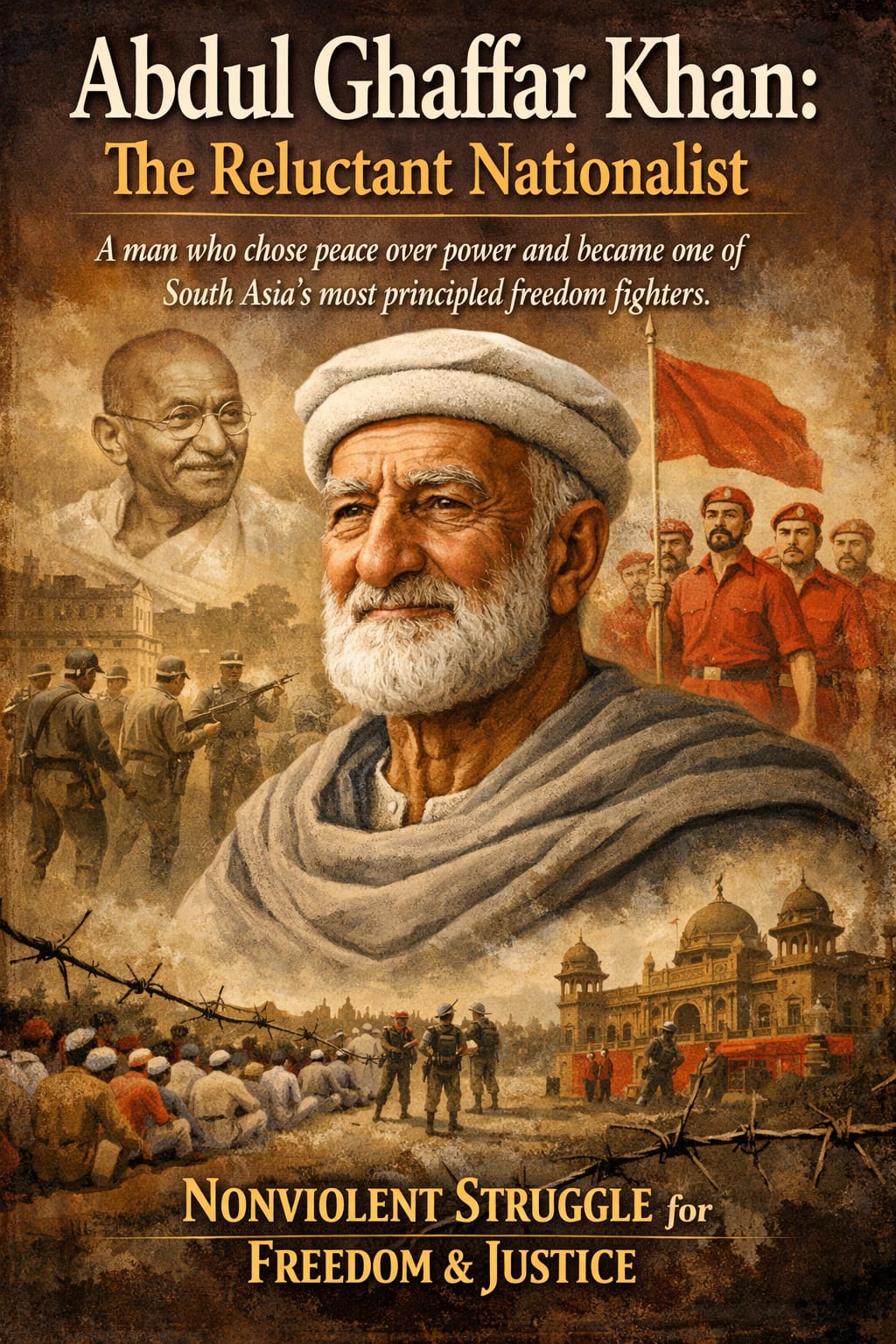
In the turbulent history of South Asia’s struggle against colonial rule, few figures stand as uniquely as Abdul Ghaffar Khan. Known to many as the “Frontier Gandhi,” Khan was a Pashtun leader who devoted his life to nonviolence, social reform, and the dignity of his people. Yet what makes his story even more remarkable is that he was often described as a “reluctant nationalist.” Rather than chasing political power or personal glory, Abdul Ghaffar Khan saw nationalism as a responsibility forced upon him by the suffering of his people.
Born in 1890 in the village of Utmanzai in the North-West Frontier Province (now in Pakistan), Ghaffar Khan grew up in a traditional Pashtun society that was deeply shaped by tribal customs and the harsh realities of colonial rule. The British Empire governed the region with strict military control, often treating the Pashtun tribes as rebellious and difficult to manage. In such an environment, resistance was common, but it usually took the form of armed struggle.
Ghaffar Khan, however, chose a different path.
From a young age, he believed that the real weakness of his society was not simply colonial domination but a lack of education and unity. Instead of organizing armed resistance, he focused on social reform. He opened schools, encouraged education among Pashtun youth, and urged people to abandon tribal feuds that had divided their communities for generations.
His commitment to peaceful reform gradually transformed him into a political leader. In 1929, he founded the Khudai Khidmatgar movement, often translated as “Servants of God.” Members of this movement wore distinctive red uniforms and became popularly known as the “Red Shirts.” Their mission was revolutionary in a region famous for warrior traditions: they pledged to follow strict discipline and practice nonviolence in their struggle against British rule.
For many observers, the idea of a nonviolent Pashtun movement seemed impossible. The British themselves had long believed that the Pashtuns understood only force. Yet Ghaffar Khan proved them wrong. Thousands of volunteers joined the Khudai Khidmatgar movement, training themselves to remain peaceful even when facing arrests, beatings, and gunfire.
His philosophy of nonviolence drew him close to Mahatma Gandhi and the Indian National Congress. The two leaders shared a deep respect for each other, and their friendship strengthened the alliance between the Pashtun nonviolent movement and the broader Indian independence struggle. However, Ghaffar Khan’s vision was always rooted in the welfare of his own people. His ultimate goal was not simply independence from Britain but the moral and social awakening of Pashtun society.
Despite his commitment to peace, Ghaffar Khan spent a large portion of his life in prison. The British authorities saw his growing influence as a threat, and he was arrested numerous times. Even after the creation of Pakistan in 1947, his political struggles did not end. His opposition to the partition of India and his demand for greater autonomy for the Pashtun region brought him into conflict with the new state authorities.
As a result, he continued to face imprisonment and political isolation in the decades that followed. Yet through all these hardships, he never abandoned his principles. He consistently preached unity, tolerance, and nonviolence, even when his own followers felt frustrated or angry.
This is why many historians describe him as a reluctant nationalist. Unlike many political leaders who seek fame or authority, Ghaffar Khan did not pursue leadership for its own sake. He entered politics because he believed it was necessary to uplift his community and defend their rights. Nationalism, for him, was not about power but about responsibility.
His life offers a powerful lesson in moral courage. In a region often associated with conflict and militancy, Ghaffar Khan demonstrated that nonviolence could also take root in the most unlikely places. His movement showed that courage does not always come from the battlefield; sometimes it comes from the willingness to stand unarmed in the face of oppression.
Abdul Ghaffar Khan passed away in 1988, but his legacy remains deeply relevant today. He is remembered not only as a freedom fighter but as a visionary who believed that peace and justice were stronger than weapons.
In the end, the story of Abdul Ghaffar Khan is the story of a man who never wanted to be a nationalist hero, yet became one because his conscience left him no other choice.
About the Creator
Irshad Abbasi
Ali ibn Abi Talib (RA) said 📚
“Knowledge is better than wealth, because knowledge protects you, while you have to protect wealth.
Keep reading
More stories from Irshad Abbasi and writers in History and other communities.
The “Bhagat Singh of Sindh” Remembered in India but Forgotten in His Own Homeland
History is filled with stories of brave individuals who sacrificed everything for the freedom of their people. Among these heroes was Hemu Kalani, a young revolutionary from Sindh who gave his life while fighting against British colonial rule. Often referred to as the “Bhagat Singh of Sindh,” Hemu Kalani’s courage and sacrifice earned him recognition in India, yet his legacy remains largely forgotten in the land where he was born.
By Irshad Abbasi about 9 hours ago in History
My First Time Skiing and I Got Lost, Alone, in the French Alps
Looking back, I can trace some of my life’s biggest adventures to a simple action from my sister. She’d introduced me to Tommy (a very long time ago), a colleague of hers, who had overshared his penchant for Italian-looking women, and I ticked that box.
By Chantal Christie Weissabout 15 hours ago in Humans


Comments
There are no comments for this story
Be the first to respond and start the conversation.