
Common Mistakes in Medical Waste Disposal & How to Avoid Them
Navigating Medical Waste Successfully


Key Takeaways
- You need to be extra careful when discarding sharps waste to avoid injuries.
- PPEs are integral in fostering safety during medical waste disposal.
- Avoid mixing medical waste with other household trash.
It is almost impossible to exercise perfection. After all, we are all human. However, there are spaces where you need to keep the margins of error as small as possible. The medical waste disposal domain is an excellent example of this. Given the environment, where things can go south quickly, it is essential to be familiar with the necessary dos and don’ts. This goes a long way in helping you stay on the safe side.
Today’s article will highlight common disposal mistakes and the various ways to avoid them.
Types of Medical Waste
To fully understand what you are dealing with, it is imperative to be familiar with various types of medical waste.
Below are some examples:
Waste Type
- Infectious
Description: This describes waste that is suspected to contain pathogens. In many cases, it is believed to foster the transmission of diseases.
- Sharps
Description: A category of waste that contains used and unused apparatus/items that can prick, cut, or cause injury.
Some examples include knives, needles, and blades.
- Radioactive
Description: This type comprises unwanted items that have been in radioactive environments and contaminated with radionuclides.
- Pharmaceutical
Description: Medications that have expired or are no longer in use and need to be discarded fall into this category.
A widened scope could easily lead you to the unwanted water and sludge (chemical) often released by plants that manufacture medications, since they also belong here.
- Non-harzadous
Description: A general type of waste comprising trash that is not considered to pose any significant hazard. Cardboard, office items, and plastic are some great examples.
The Mistakes
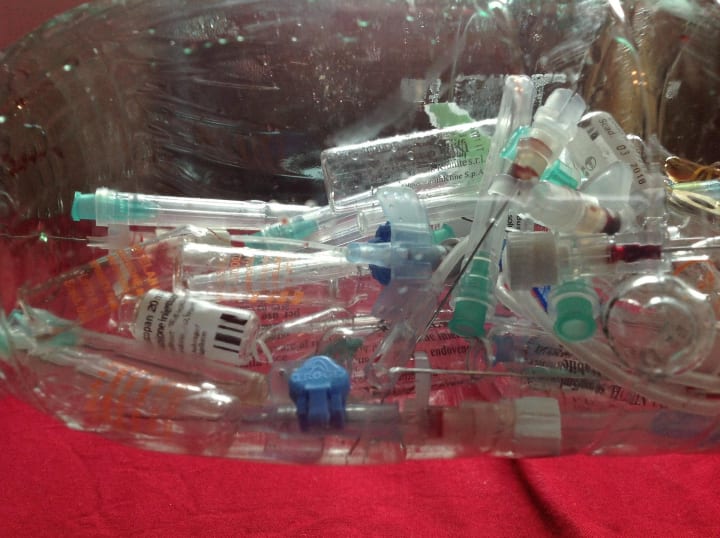
Here are a few mistakes people often make when it comes to handling medical waste:
- Mixing Waste
In healthcare facilities, different departments carry out various roles. For this reason, the resulting waste is often different, with each type usually having its own discarding procedures.
That is why it is advisable not to mix them. Many people do this, and it is entirely wrong.
Some people even mix medical waste with household waste. This occurs mainly among those who perform related tasks at home. Again, this is a pitfall, as it raises various safety concerns.
How to Avoid: The correct approach here is to practice segregation. When in a facility, ensure you separate waste types and discard them in their designated containers with clear markings.
The same principle applies at home. You can have specific bags for household refuse and separate containers for medical waste. Additionally, ensure you do not place the two too close together to prevent accidental mixing.
- Treating Sharps Like the Rest
According to data from the World Health Organization, around 16 billion injections are administered worldwide. However, not all syringes and needles are disposed of correctly after the procedures are complete.
It may be difficult to pinpoint the exact reason for this. However, a common mistake in this space is treating sharps waste as if it were other types. This is problematic because of the significant danger they pose.
How to Avoid: Right from the beginning, you need to have containers for sharps, which are special containers for throwing away sharps waste. In most cases, these are narrow-mouthed containers, often heavy-duty and leak-resistant, and they can be sealed with ease.
- Letting Untrained Personnel Handle the Waste
Allowing untrained personnel to dispose of medical waste is a key mistake that often has severe consequences. Here, you will find that many of them do not classify waste or do so improperly, raising several safety concerns.
Because they lack the necessary training and understanding of the domain, they may seem to be walking into a den of lions, utterly unaware of the lurking danger.
How to Avoid: One effective way to address this issue is to properly train staff on proper medical waste disposal. Practices such as waste separation and regulatory rules can be clearly articulated, understood, and implemented to foster best practices.
- Lack of Proper Equipment
Another big mistake people make in this space is not having the right equipment/protective gear, which can expose them to a wide variety of risks. Luckily, there is a way of avoiding all of this.
How to Avoid: One can start by picking up disposable personal protective equipment, which includes gloves, a gown, a mask, and more.
The benefits of doing so include:
- Control of transmissions: Helps maintain strict hygiene standards. This is because when used correctly, these can go a long way in limiting the transmission of pathogens and contamination risks.
- Minimizing cross-contamination: When moving from task to task, personnel dispose of PPE and put on new PPE. This helps reduce the risk of contaminants from one side transferring to the other.
Side Note: Because these items are designed for discarding after use, cleaning and maintenance procedures are reduced. The convenience this offers is immense.
- Flushing
This often involves disposing of medications by flushing them down the toilet. Disposing of pharmaceutical waste in such a way can seriously contaminate the water supply.
The effects can then spread to the aquatic life, causing severe repercussions. The story does not end there; these effects may even be passed on to human beings through drinking water.
How to Avoid: In addition to using designated containers, you can take your waste to institutions or areas that offer take-back programs so it can be disposed of appropriately.
Safe Disposal Starts With Proper Procedures
The price one may pay for waste disposal mistakes can sometimes be too high. For that reason, it is important to put measures in place to minimize and, when possible, avoid them. For example, it is not advisable to handle sharps in an unstructured manner. One effective way to address this is by disposing of them in their designated waste containers. This is just one example. Adhering to proper procedures, such as those outlined above, helps ensure safe and compliant waste disposal.
About the Creator
Aaron Smith
Aaron is a content strategist and consultant in support of STEM firms and medical practices. He covers industry developments and helps companies connect with clients. In his free time, he enjoys swimming, swing dancing, and sci-fi novels.
Keep reading
More stories from Aaron Smith and writers in Humans and other communities.
Digital Product Passports: What Businesses Need to Do Now
Key Takeaways Digital Product Passports signal a shift toward supply chain transparency. Businesses that wait for enforcement deadlines risk rushed system upgrades and costly operational disruption. Preparing now means mapping data, strengthening supplier accountability, and running pilot programs. Companies that treat DPPs as a strategic advantage can build trust and gain a competitive edge.
By Aaron Smith3 days ago in Journal
Why Didn't Anyone Tell Us
Men, move along. This is not for you. This is for the women. I was forty-five when I began menopause. It is pretty young for that to be going on in a woman’s life, but I had undiagnosed PCOS, my entire life. Thank you to all the gynecologists I had seen my entire life. That in itself should encourage women to keep seeking second opinions, especially when you are not getting correct answers or any at all.
By Alexandra Grant2 days ago in Humans
The Empty Chair
There is a chair in our living room that no one sits in anymore. It’s not broken. The wood is still strong, the cushion still soft enough to be comfortable. From the outside, it looks like just another piece of furniture in the house. But for me, it means something entirely different. It is the empty chair. And every time I see it, a flood of memories comes rushing back.
By Shoaib Afridi2 days ago in Humans
Worth the Wait: Puerto Viejo, Costa Rica
Beach bumming in a small Caribbean beach town sounded like a perfect way to end our 6-month trip through Mexico and Central America. Or so we thought. The foul, fishy stench of rotten seaweed hit our nostrils as we stepped from the cramped bus and looked out at a rather depressing, empty, and underwhelming black sand beach. It was pouring with rain, and we had to quickly fish out our ponchos. We thought, this couldn’t be it, could it?
By Sh*t Happens - Lost Girl Travel6 days ago in Wander




Comments
There are no comments for this story
Be the first to respond and start the conversation.