
How Abuse Wounds Both the Victim and the Abuser
A clear reflection on how abuse damages the one harmed, distorts the one causing harm, and leaves truth, healing, and accountability as the only way forward.

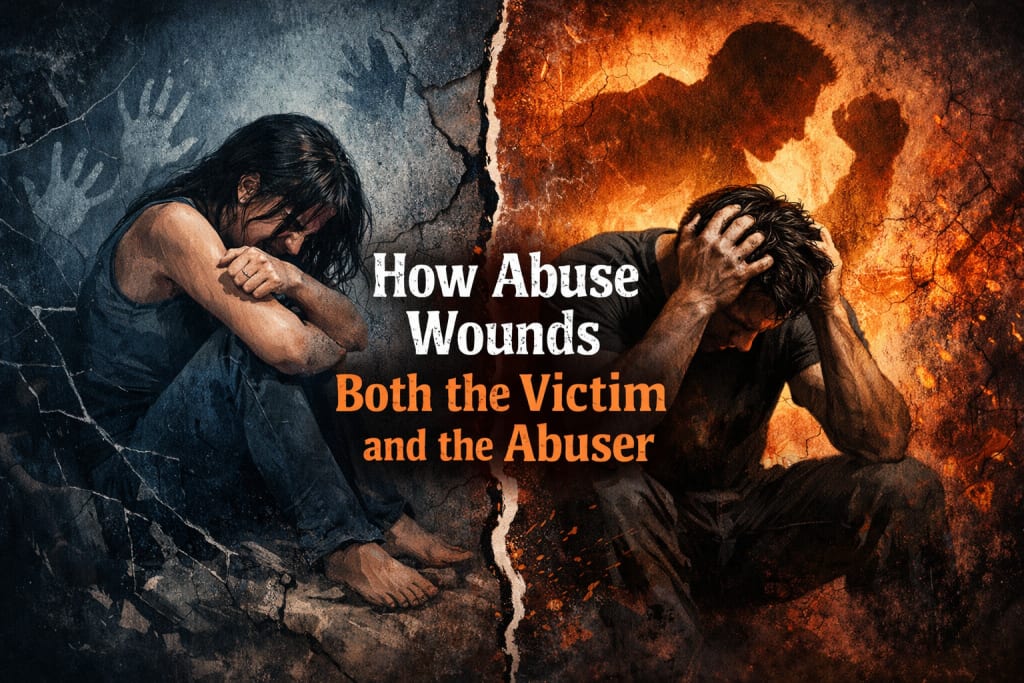
Abuse scars the victim, distorts the abuser, and ripples through everything it touches. Healing begins where truth is finally named.
An honest reflection on how abuse affects both victim and abuser, exploring trauma, accountability, broken cycles, emotional harm, and the difficult path toward healing.
Abuse is often spoken about through the pain of the victim, and rightly so. The victim carries wounds that can shape the nervous system, distort self-worth, fracture trust, and leave lasting imprints on the body, mind, and spirit. Abuse can make a person question their reality, silence their voice, and confuse love with fear. It can teach survival where safety should have lived. It can leave someone fighting to feel whole again long after the moment has passed.
But abuse does not only reveal the suffering of the one harmed. It also exposes the deep disorder within the one causing harm.
This does not excuse abuse. It does not soften accountability. It does not ask the wounded to carry compassion before they have carried themselves back to safety. But it does tell the truth: abuse damages everyone it touches.
The victim may leave with trauma, fear, shame, hypervigilance, grief, or a fractured relationship with their own worth. They may spend years learning that what happened to them was not love, not discipline, not passion, not protection. They may have to rebuild the ability to trust their own voice. They may need to learn that softness is not weakness, boundaries are not cruelty, and peace is not something that must be earned through suffering.
The abuser, however, is not untouched by what they do. A person who abuses another is also living inside a broken pattern. Somewhere within them, humanity has been distorted. They may be ruled by unhealed pain, entitlement, control, fear, insecurity, rage, addiction, learned violence, or a desperate need for power. Again, this does not remove responsibility. In fact, it sharpens it. Because abuse is not only harm done outwardly. It is also evidence of harm left unaddressed inwardly.
To abuse someone is to live at war with truth.
It is to mistake domination for strength.
To mistake fear for respect.
To mistake control for love.
To mistake another person’s silence for innocence.
The victim suffers the impact.
The abuser becomes the source of impact.
Both are living inside damage, but not in the same way, and never with the same moral weight.
That distinction matters.
The victim deserves protection, support, validation, space, and healing.
The abuser deserves accountability, interruption, truth, and if they are willing, deep transformational work.
Healing for the victim must never depend on the abuser changing.
But real change for the abuser can never begin without facing the harm they caused.
Abuse creates a tragic split in human connection. One person is forced to carry pain they did not choose. The other becomes someone capable of inflicting pain they refused to confront within themselves. One is robbed. The other becomes a robber of peace. One learns to survive. The other may lose the ability to love without power attached.
That is the devastation of abuse.
It destroys safety in the victim.
It destroys integrity in the abuser.
And yet, this truth also reveals something important: cycles can be broken.
Victims can heal.
They can reclaim voice, body, truth, trust, and dignity.
They can learn that what happened to them does not define their value.
They can stop confusing survival patterns with identity.
They can become living proof that pain does not get the final word.
Abusers, too, if genuinely willing, can face themselves without excuses.
They can tell the truth about what they have done.
They can stop performing remorse and begin practicing change.
They can seek intervention, treatment, accountability, and transformation.
But none of that matters without real ownership.
Not blame-shifting. Not image management. Not selective honesty.
Truth.
Full truth.
Because healing cannot grow where denial is still being fed.
Abuse is not just an event. It is a corruption of relationship, power, and trust. It teaches the wrong lessons to everyone involved. But truth can teach new ones.
The victim can learn:
I did not deserve this.
What hurt me is not my identity.
My boundaries are sacred.
My voice matters.
The abuser, if they choose the harder road, must learn:
I caused harm.
My pain does not justify my violence.
Control is not love.
Change requires truth, not performance.
In the end, abuse leaves no one untouched.
It scars the victim.
It deforms the abuser.
It ripples through families, communities, and generations.
That is why we must speak of it clearly.
Not to blur responsibility.
Not to pity cruelty.
But to understand how deeply harm spreads when it is left unchecked.
And also to remember:
what is learned can be unlearned,
what is broken can be named,
what is named can be faced,
and what is faced truthfully can begin, at last, to heal.
Author Note Abuse must never be excused, softened, or spiritually bypassed. This piece names a difficult truth: abuse deeply wounds the victim, while also revealing the inner distortion of the abuser. The harm is not equal, and the responsibility is not shared in the same way, but the damage spreads far beyond a single moment. This reflection was written to hold space for truth, accountability, protection, and the possibility of breaking cycles that were never meant to be inherited.
—Flower InBloom
About the Creator
Flower InBloom
I write from lived truth, where healing meets awareness and spirituality stays grounded in real life. These words are an offering, not instruction — a mirror for those returning to themselves.
— Flower InBloom
Keep reading
More stories from Flower InBloom and writers in Humans and other communities.
Transitioning Realms: How 4D Serves as the Gateway to Higher Awareness.
The concept of dimensional consciousness has captivated spiritual seekers, quantum enthusiasts, and philosophers alike for decades. While much attention has been given to the shift from 3D to 5D reality—as discussed in various metaphysical teachings—the 4D consciousness often emerges as the crucial "bridge" in this evolutionary journey. But what exactly is 4D consciousness, and how does it function as a connector between the dense, material world of 3D and the unified, love-centered expanse of 5D? This exploration delves into the nature of 4D, its role as a transitional state, the signs of inhabiting it, and practical ways to navigate this bridge toward higher dimensions.
By Wilson Igbasi5 days ago in Humans


Comments
There are no comments for this story
Be the first to respond and start the conversation.