
Industrial Enzymes Market Size and Forecast 2026–2034
Sustainable Manufacturing and Biotechnology Innovation Accelerate Global Demand for Industrial Enzymes

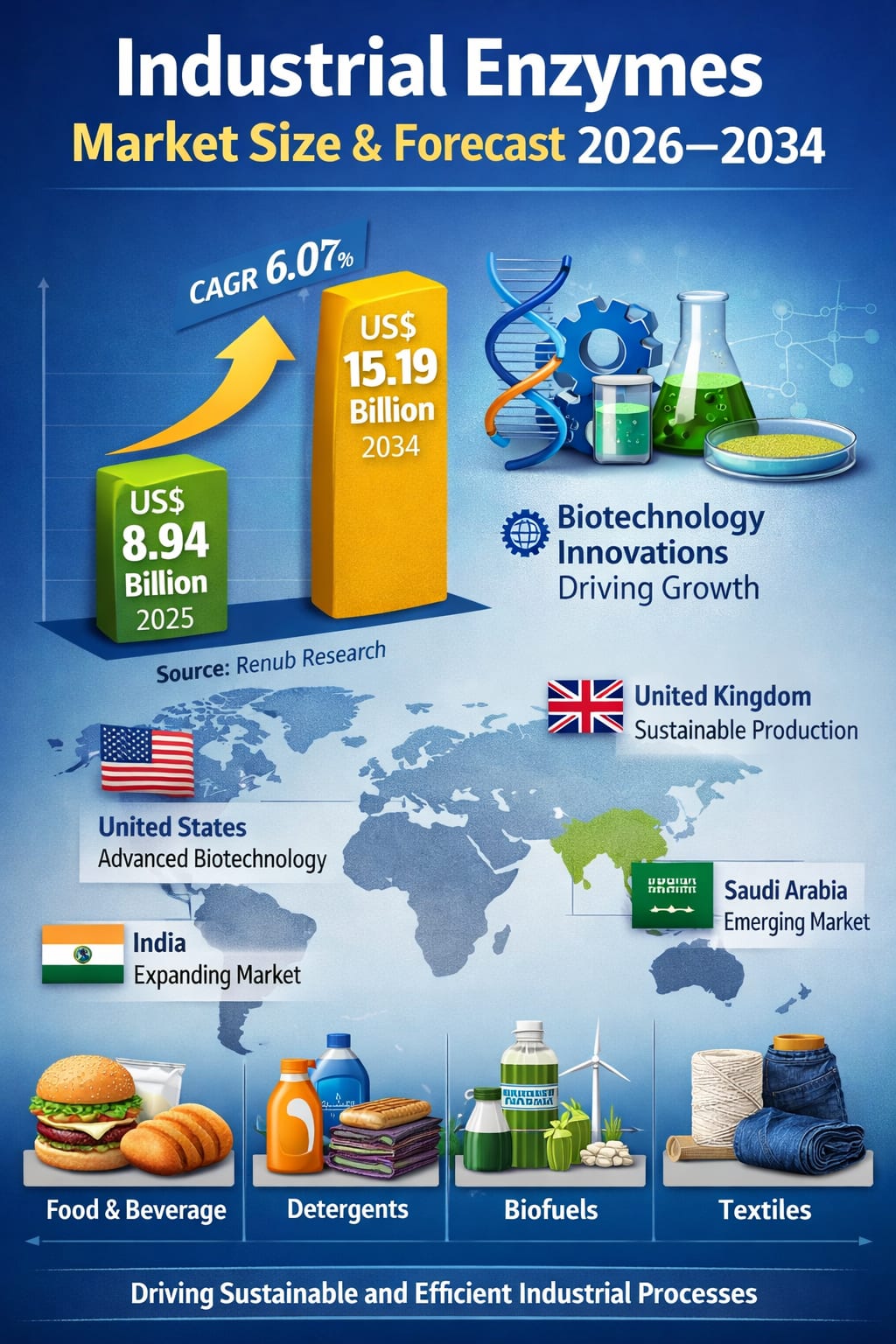
Industrial enzymes have become a crucial component of modern manufacturing, offering sustainable and efficient alternatives to traditional chemical processes. As industries increasingly shift toward environmentally responsible production methods, the demand for enzyme-based solutions continues to expand rapidly.
According to insights from Renub Research, the industrial enzymes market is projected to grow from US$ 8.94 Billion in 2025 to US$ 15.19 Billion by 2034, registering a compound annual growth rate (CAGR) of 6.07% between 2026 and 2034. This growth reflects the increasing integration of enzyme technologies across multiple industries, including food and beverages, detergents, textiles, biofuels, pharmaceuticals, and agriculture.
Industrial enzymes function as biological catalysts that accelerate chemical reactions without being consumed in the process. Derived primarily from microorganisms, plants, or animals, these enzymes enable industries to achieve improved productivity, lower energy consumption, and reduced environmental impact. As global sustainability initiatives gain momentum, industrial enzymes are becoming indispensable tools in transforming traditional manufacturing into greener and more efficient processes.
Understanding Industrial Enzymes and Their Industrial Importance
Industrial enzymes are specialized proteins capable of catalyzing chemical reactions in various industrial applications. Unlike conventional chemical catalysts that often require harsh conditions, enzymes operate efficiently under mild temperatures and neutral pH levels. This capability significantly reduces energy usage and minimizes the generation of harmful byproducts.
Several types of enzymes dominate the industrial market. Amylases are widely used in food processing and starch conversion, while proteases break down proteins and are heavily utilized in detergents and food manufacturing. Lipases catalyze fat breakdown and play a critical role in biodiesel production and flavor development in foods. Cellulases help decompose cellulose and are widely applied in textiles, biofuel production, and paper manufacturing.
By replacing chemical-intensive processes, industrial enzymes contribute to lower operational costs, improved product quality, and reduced environmental pollution. As a result, industries across the globe are increasingly integrating enzyme-based processes to meet sustainability goals while maintaining operational efficiency.
Growing Demand for Sustainable and Eco-Friendly Manufacturing
One of the most powerful drivers of the industrial enzymes market is the global push toward sustainable and environmentally friendly production systems. Governments, regulatory bodies, and consumers are placing increasing pressure on industries to reduce their carbon footprint and minimize chemical waste.
Industrial enzymes offer a practical solution to these challenges. Being biodegradable and renewable, they support the principles of green chemistry and circular economy practices. By enabling reactions at lower temperatures and with reduced chemical inputs, enzymes significantly lower energy consumption and emissions.
Businesses are also adopting enzyme-based processes to comply with stricter environmental regulations and sustainability commitments. Many companies now see industrial enzymes not only as operational tools but also as strategic assets for improving their environmental performance.
Recent innovations highlight the industry’s direction. In November 2024, biotechnology firm VTR Biotech introduced new enzyme solutions, including the advanced xylanase product “Yiduozyme” and the detergent enzyme system “Yibeijia Com Series.” These innovations demonstrate the growing focus on sustainable technologies and high-efficiency enzyme solutions designed to meet modern industrial demands.
Expanding Applications in Food and Detergent Industries
The food and beverage sector represents one of the largest markets for industrial enzymes. Enzymes help improve taste, texture, shelf life, and nutritional value in a wide range of products. They are commonly used in baking, dairy processing, brewing, and beverage production.
For example, enzymes assist in breaking down starches during bread making, improving dough elasticity and product consistency. In dairy production, enzymes help enhance fermentation processes and improve the texture of yogurt and cheese.
The detergent industry is another major consumer of industrial enzymes. Enzymes such as proteases, lipases, and amylases help remove stubborn stains from fabrics while enabling detergents to work effectively at lower temperatures. This reduces both energy consumption and water usage during laundry processes.
Innovation continues to shape this sector. In November 2024, IFF introduced TEXSTAR™, an advanced enzymatic texturizing solution designed to enhance the viscosity and texture of both dairy and plant-based fermented products without requiring stabilizers. Such innovations highlight the expanding possibilities for enzymes in modern food production.
Technological Advancements in Enzyme Engineering
Rapid developments in biotechnology and genetic engineering are significantly expanding the potential applications of industrial enzymes. Techniques such as protein engineering, directed evolution, and genetic modification allow scientists to design enzymes with enhanced stability, efficiency, and performance under challenging industrial conditions.
These advances are making enzymes more adaptable to extreme temperatures, varying pH levels, and complex chemical environments. As a result, industries that previously relied solely on chemical catalysts are now able to incorporate enzyme-based solutions into their processes.
In May 2024, biotechnology company Bionetix International announced the commercial availability of ECL3000, an enzyme concentrate designed to break down cellulose. This innovation supports manufacturers in industries such as paper, textiles, and agriculture by enabling more efficient and environmentally friendly production processes.
As biotechnology research continues to advance, customized enzymes tailored to specific industrial needs are becoming increasingly common. This trend is expected to play a major role in driving future growth in the industrial enzymes market.
Key Challenges Facing the Industrial Enzymes Market
Despite strong growth prospects, the industrial enzymes market faces several challenges that could influence its development.
High Production Costs
Producing industrial enzymes often requires advanced biotechnology facilities, specialized fermentation techniques, and strict quality control systems. These factors contribute to relatively high production costs compared to traditional chemical catalysts.
For smaller manufacturers operating in highly competitive industries, the upfront costs associated with adopting enzyme-based processes can be a barrier. As a result, companies must balance the long-term sustainability benefits of enzymes with the short-term economic considerations of their production systems.
Stability and Process Compatibility
Another challenge involves the stability of enzymes under certain industrial conditions. Some enzymes may lose activity when exposed to extreme temperatures, high acidity, or harsh chemical environments.
Researchers are actively working to improve enzyme stability and adaptability through advanced biotechnology techniques. However, until these challenges are fully addressed, certain industrial processes may still rely on traditional chemical methods.
Segment Insights: Lipases and Proteases
Among the various enzyme categories, lipases and proteases represent some of the fastest-growing segments in the industrial enzymes market.
Lipases catalyze the breakdown of fats and oils and are widely used in food processing, biodiesel production, detergents, and pharmaceuticals. Their ability to enhance flavor development and improve oil modification processes has made them particularly valuable in the food industry.
Proteases, on the other hand, are essential for breaking down proteins into smaller peptides and amino acids. These enzymes are widely used in detergents, food processing, leather treatment, and pharmaceuticals. Because they effectively remove protein-based stains, proteases are among the most widely used enzymes in laundry detergents.
Continuous improvements in enzyme efficiency and thermal stability are further driving the demand for these enzyme types across multiple industries.
Industrial Enzymes in Food, Textiles, and Plant-Based Solutions
The food and beverage sector remains the dominant application segment for industrial enzymes. With rising global demand for processed foods and clean-label ingredients, food manufacturers are increasingly adopting enzyme technologies to enhance product quality and reduce reliance on chemical additives.
In the textile industry, enzymes such as cellulases and amylases are used for fabric processing processes like desizing, bio-polishing, and denim finishing. These enzyme-based techniques reduce water usage and chemical waste while improving fabric quality.
Another emerging trend is the growing interest in plant-derived enzymes. These enzymes align with consumer preferences for natural and plant-based products. They are increasingly used in food processing, biofuel production, and agricultural applications.
Advances in plant enzyme extraction and processing technologies are improving production yields, making plant-derived enzymes a viable option for industrial-scale applications.
Regional Insights: United States, United Kingdom, India, and Saudi Arabia
United States
The United States represents one of the most advanced markets for industrial enzymes due to its strong biotechnology infrastructure and well-established research ecosystem. The country’s food processing, biofuel, detergent, and pharmaceutical industries are major consumers of enzyme solutions.
In January 2023, Cargill and BASF expanded their partnership to introduce advanced enzyme solutions aimed at improving efficiency and sustainability in the U.S. animal protein industry.
United Kingdom
The United Kingdom’s industrial enzymes market is driven by the country’s strong focus on sustainability and green manufacturing. Demand is particularly strong in food processing sectors such as baking, brewing, and dairy production.
In April 2024, biotech company Prozomix partnered with Ginkgo Bioworks to develop next-generation enzyme plates for active pharmaceutical ingredient (API) manufacturing.
India
India’s industrial enzymes market is expanding rapidly due to industrial growth and increasing demand from sectors such as food processing, textiles, detergents, and biofuels. Government support for renewable energy and biotechnology development is also encouraging enzyme adoption.
In April 2025, NOVUS launched the CIBENZA® XCEL Xylanase enzyme feed additive in India to improve nutrient utilization in poultry production.
Saudi Arabia
Saudi Arabia’s industrial enzymes market is still emerging but shows strong potential as the country diversifies its economy under the Vision 2030 initiative. Growth in food processing, detergents, and bio-industries is expected to drive enzyme adoption in the region.
Competitive Landscape
The industrial enzymes market is highly competitive, with leading biotechnology and chemical companies investing heavily in research and product innovation. Key players include:
BASF SE
Advanced Enzyme Technologies
Novozymes
DuPont Danisco
DSM
Kerry Group PLC
Dyadic International Inc.
Associated British Foods Plc
These companies focus on technological innovation, strategic partnerships, and expansion into emerging markets to strengthen their global market position.
Final Thoughts
The industrial enzymes market is entering a transformative period as industries worldwide shift toward sustainable manufacturing and environmentally responsible production methods. Enzyme technologies provide an effective solution for reducing energy consumption, minimizing chemical waste, and improving operational efficiency.
With the market expected to grow from US$ 8.94 Billion in 2025 to US$ 15.19 Billion by 2034, industrial enzymes are poised to play a critical role in the future of global manufacturing.
As biotechnology continues to evolve and new enzyme solutions emerge, industries ranging from food production to renewable energy will increasingly rely on these powerful biological catalysts to build a more sustainable and efficient industrial ecosystem.
About the Creator
Why Didn't Anyone Tell Us
Men, move along. This is not for you. This is for the women. I was forty-five when I began menopause. It is pretty young for that to be going on in a woman’s life, but I had undiagnosed PCOS, my entire life. Thank you to all the gynecologists I had seen my entire life. That in itself should encourage women to keep seeking second opinions, especially when you are not getting correct answers or any at all.
By Alexandra Grant3 days ago in Humans


Comments
There are no comments for this story
Be the first to respond and start the conversation.