
Microgrid Market Size and Forecast 2026–2034: Building the Future of Decentralized Energy
Rising demand for energy resilience, renewable integration, and smart grid innovation is driving strong growth in the global microgrid market.

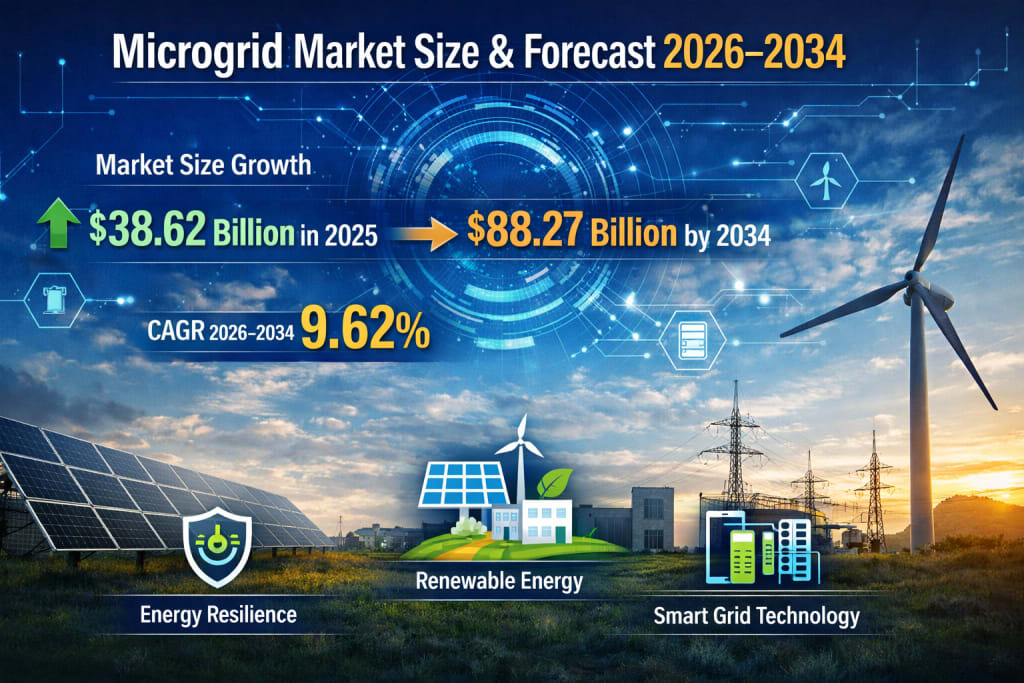
Microgrid Market Size and Forecast 2026–2034
The global microgrid market is poised for remarkable growth in the coming years as nations and organizations focus on resilient, decentralized, and sustainable energy systems. According to Renub Research, the microgrid market is expected to grow from US$ 38.62 billion in 2025 to US$ 88.27 billion by 2034, expanding at a compound annual growth rate (CAGR) of 9.62% between 2026 and 2034.
This strong expansion reflects the increasing need for reliable electricity supply, growing adoption of renewable energy sources, and rising investments in energy independence. Governments around the world are implementing supportive policies, electrification programs, and clean energy initiatives that are accelerating microgrid deployment. At the same time, technological advancements in energy storage, smart grid infrastructure, and digital power management systems are strengthening the economic and operational viability of microgrid solutions.
As the global energy landscape evolves, microgrids are emerging as a critical component of modern electricity systems, enabling communities, industries, and institutions to produce and manage power locally while enhancing resilience and sustainability.
Microgrid Market Outlook
A microgrid is a localized energy system capable of generating, distributing, and managing electricity independently or in conjunction with the main grid. Unlike traditional centralized electricity networks, microgrids operate on a smaller scale and integrate multiple energy sources such as solar power, wind energy, natural gas generators, and battery storage systems.
These systems rely on advanced energy management technologies to maintain balance between electricity generation and consumption. Intelligent control platforms monitor demand, manage distributed resources, and ensure seamless transitions between grid-connected and islanded operation.
Microgrids are commonly deployed in a variety of environments, including:
Remote and rural communities
Commercial and industrial facilities
Hospitals and healthcare centers
Military installations
University campuses
Data centers and telecommunications infrastructure
In areas where the main electricity grid is unstable or unavailable, microgrids provide an effective solution for reliable energy access. Even in regions with developed power infrastructure, microgrids enhance energy security by ensuring continuity of operations during outages or natural disasters.
Globally, interest in microgrid technology is rising as governments, utilities, and private organizations explore decentralized energy models that can improve efficiency, reduce transmission losses, and support renewable energy integration.
Growth Drivers of the Microgrid Market
Increasing Demand for Reliable and Resilient Power Supply
One of the most significant factors fueling the growth of the microgrid market is the rising demand for reliable and uninterrupted electricity supply. Traditional centralized grids are increasingly vulnerable to disruptions caused by extreme weather events, equipment failures, cyber threats, and aging infrastructure.
In contrast, microgrids offer a decentralized and resilient energy solution. They can operate independently from the main grid during outages, ensuring uninterrupted electricity for critical operations. Hospitals, emergency services, defense facilities, and industrial plants increasingly rely on microgrid systems to guarantee operational continuity.
As climate change intensifies the frequency of natural disasters such as hurricanes, floods, and wildfires, governments and organizations are prioritizing energy resilience. Microgrids enable localized power generation, minimizing downtime and reducing economic losses caused by grid disruptions.
A notable industry development occurred in November 2025, when ABB partnered with VoltaGrid to provide grid stabilization solutions supporting the rising power demands of artificial intelligence data centers in the United States. The project included synchronous condensers, power control systems, and prefabricated energy units designed to enhance grid stability and energy reliability.
Rising Integration of Renewable Energy Sources
The global transition toward renewable energy is another major driver of microgrid adoption. Solar and wind energy are rapidly expanding worldwide, but their intermittent nature requires intelligent management and storage solutions.
Microgrids provide an ideal platform for integrating renewable resources. Advanced control systems enable efficient management of energy generation, storage, and distribution while maintaining stability within the network.
Battery storage technologies play a crucial role in this process by storing surplus renewable energy and releasing it when demand increases. As the cost of solar panels, wind turbines, and battery systems continues to decline, microgrids are becoming more economically viable.
Many governments and corporations are implementing sustainability strategies that prioritize clean energy solutions. Microgrids support these initiatives by reducing reliance on fossil fuels and lowering greenhouse gas emissions.
In October 2025, Honeywell partnered with LS Electric to develop integrated hardware and software solutions for data centers facing power demand challenges. By combining Honeywell’s AI-based platform with LS Electric’s energy technologies, the collaboration aims to enhance battery storage and microgrid efficiency.
Government Support and Rural Electrification Initiatives
Government policies and electrification programs are playing a crucial role in accelerating the microgrid market. In many developing regions, centralized grid infrastructure remains limited, particularly in remote and rural areas.
Microgrids offer a practical and scalable solution for expanding electricity access. Governments and international organizations are increasingly investing in microgrid projects to improve energy access and support economic development.
Financial incentives, subsidies, and policy frameworks are encouraging private-sector participation in microgrid deployment. These initiatives are also aligned with broader goals such as smart city development and sustainable energy infrastructure.
For example, in May 2025, Bloom Energy Corporation partnered with NTPC Limited in India to develop a green hydrogen-powered microgrid at Simhadri in Visakhapatnam. The project integrates a floating solar farm with hydrogen fuel cell technologies to provide carbon-neutral power, supporting India’s National Green Hydrogen Mission and strengthening the country’s clean energy ecosystem.
Challenges of the Microgrid Market
High Initial Investment and Installation Costs
Despite its advantages, microgrid deployment requires significant upfront investment. Infrastructure development involves multiple components, including energy generation equipment, storage systems, distribution networks, and advanced control technologies.
Battery storage solutions, which are essential for renewable energy integration, can further increase installation costs. For many communities and businesses, particularly in developing countries, the high initial investment presents a major barrier.
Although microgrids can generate long-term cost savings through improved efficiency and reduced fuel consumption, financing challenges often slow project implementation. Expanding access to funding mechanisms, public-private partnerships, and innovative financing models will be essential for accelerating microgrid adoption.
Regulatory and Technical Integration Challenges
Another major challenge in the microgrid market is the complexity of regulatory frameworks and technical integration requirements.
Microgrid systems must comply with regional electricity regulations, grid interconnection standards, and safety requirements. These rules vary significantly across countries and regions, creating challenges for developers and operators.
Additionally, integrating microgrids with existing power infrastructure requires advanced technologies and specialized expertise. Operators must manage multiple energy sources while ensuring grid stability and maintaining consistent power quality.
In regions where regulatory frameworks are still evolving, these challenges can delay project approvals and increase operational complexity. Addressing these regulatory and technical issues will be crucial for unlocking the full potential of microgrid systems.
Key Microgrid Market Segments
Natural Gas Microgrids
Natural gas microgrids remain widely used due to their ability to provide consistent and reliable electricity generation. These systems rely on natural gas-powered generators to ensure continuous energy supply for critical infrastructure and industrial operations.
Compared with coal and diesel, natural gas produces lower carbon emissions, making it a relatively cleaner fossil fuel option. Natural gas microgrids also provide operational flexibility, allowing integration with renewable energy sources to create hybrid energy systems.
Solar PV Microgrids
Solar photovoltaic microgrids are experiencing rapid growth as demand for renewable energy increases worldwide. These systems reduce dependence on fossil fuels while lowering carbon emissions.
Solar microgrids are particularly beneficial in remote communities where grid connectivity is limited. By combining solar panels with battery storage, these systems provide electricity even during nighttime or cloudy weather conditions.
Over the long term, solar microgrids can significantly reduce electricity costs while supporting sustainable development initiatives.
Government Microgrids
Government microgrids are designed to ensure reliable power supply for critical public infrastructure such as military bases, hospitals, emergency response centers, and government facilities.
These systems enhance national energy security by maintaining operations during grid disruptions or natural disasters. Many governments are investing in microgrid development as part of broader smart city and energy resilience strategies.
Government-backed projects also promote the adoption of renewable energy and advanced energy storage technologies.
Grid-Connected Microgrids
Grid-connected microgrids operate alongside the main electricity grid while retaining the capability to disconnect during emergencies.
These systems enable organizations to generate their own electricity while exporting surplus energy back to the grid. By reducing transmission losses and optimizing energy use, grid-connected microgrids improve overall system efficiency.
Industries, campuses, and commercial facilities increasingly adopt grid-connected microgrids to reduce energy costs and enhance operational flexibility.
DC Microgrids
Direct current (DC) microgrids represent an emerging innovation in distributed energy systems. Many modern energy technologies—including solar panels, batteries, and electric vehicle chargers—operate using DC power.
DC microgrids minimize energy losses caused by AC-to-DC conversion, improving system efficiency. They are particularly suitable for applications such as data centers, telecommunications networks, commercial buildings, and EV charging infrastructure.
As energy systems become increasingly digital and electrified, DC microgrids are expected to play a significant role in the future energy landscape.
Regional Market Insights
United States
The United States has one of the most advanced microgrid markets globally. Rising concerns about grid reliability, extreme weather events, and energy resilience have accelerated microgrid adoption across multiple sectors.
Hospitals, universities, defense facilities, and commercial campuses are investing heavily in microgrid systems to ensure uninterrupted operations. Government funding programs and supportive regulatory frameworks are further strengthening market growth.
In 2023, the U.S. Department of Energy received more than US$1.5 billion in funding applications for community microgrid installations aimed at expanding clean energy access.
United Kingdom
The United Kingdom is witnessing increasing adoption of microgrid systems as part of its broader strategy to achieve net-zero carbon emissions. Investments in renewable energy, smart grid infrastructure, and battery storage technologies are driving market growth.
Universities, industries, and commercial buildings are integrating microgrids to enhance sustainability and energy efficiency while improving grid resilience.
Saudi Arabia
Saudi Arabia presents significant growth opportunities for the microgrid market due to major investments in renewable energy and smart infrastructure development.
The country is actively pursuing diversification of its energy sector and reducing dependence on traditional fossil fuels. Large-scale renewable projects and smart city initiatives are encouraging microgrid deployment.
In September 2024, Huawei developed the world’s largest microgrid power station for the Red Sea New City project, capable of producing one billion kilowatt-hours of electricity annually using renewable energy.
Competitive Landscape
The global microgrid market is highly competitive, with several major technology providers leading innovation and project deployment. Key companies include:
ABB
Siemens AG
General Electric
Eaton Corporation
Exelon Corp.
Honeywell International Inc.
Schneider Electric SE
Hitachi Energy Ltd
These companies are focusing on strategic partnerships, technological advancements, and renewable energy integration to strengthen their market positions.
Final Thoughts
The microgrid market is entering a transformative growth phase as the global energy sector shifts toward decentralization, sustainability, and resilience. With rising demand for reliable electricity, increasing renewable energy adoption, and supportive government policies, microgrids are becoming an essential component of modern energy infrastructure.
As technological innovations continue to improve efficiency and reduce costs, microgrid systems will play a critical role in shaping the future of energy—empowering communities, industries, and nations to build cleaner, more resilient power systems for the decades ahead.
About the Creator
Hip Replacement Market Size and Forecast 2026–2034
The global Hip Replacement Market is entering a decade of stable and meaningful expansion, supported by demographic shifts, technological progress, and improved healthcare accessibility. According to Renub Research, the market was valued at US$ 8.19 billion in 2025 and is projected to reach US$ 11.97 billion by 2034, growing at a steady Compound Annual Growth Rate (CAGR) of 4.31% from 2026 to 2034.
By shibansh kumar4 days ago in Trader
Zalando Stock – Price Analysis, Growth Outlook, and Investment Insights
Zalando Stock The Zalando stock has become a major point of focus for investors interested in European e-commerce and fashion retail. As Germany’s largest online fashion platform, Zalando’s performance reflects broader trends in online shopping, consumer behavior, and market competition across Europe.
By Hammad Nawazabout 9 hours ago in Trader
Becca
"Everything is so... flat." Denille said stupidly as she looked around her new neighborhood. She looked around at the muted desert where even the smallest sign of life seemed to have given up. The plant life was shrubs that were half cooked by the heat and where there should have been a lawn, a mess of white rocks laid glistening in the sun. Even the sky looked stretched thin, like the sun had ironed it smooth. She’d moved from Riverside, where at least there were hills, but here in Barstow, everything felt baked and brittle.
By Sara Wilson8 days ago in Fiction




Comments
There are no comments for this story
Be the first to respond and start the conversation.