
Organic Fertilizer Market Size and Forecast 2026–2034
Rising Demand for Sustainable Agriculture to Drive Market Expansion

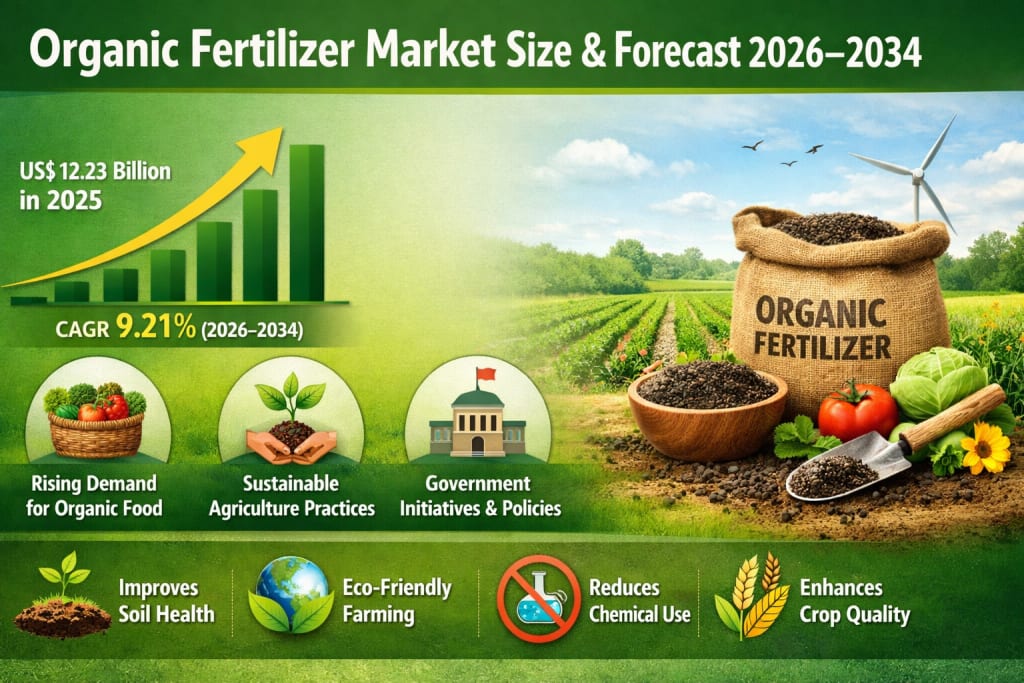
The global Organic Fertilizer Market is witnessing strong momentum as agriculture worldwide shifts toward sustainability and environmentally friendly practices. According to Renub Research, the Organic Fertilizer Market is projected to grow from US$ 12.23 Billion in 2025 to US$ 27.03 Billion by 2034, expanding at a Compound Annual Growth Rate (CAGR) of 9.21% from 2026 to 2034.
This rapid expansion is primarily driven by the rising demand for organic food products, increasing environmental awareness, and supportive government initiatives encouraging eco-friendly agricultural practices. Organic fertilizers help improve soil health, reduce environmental damage, and enhance crop quality, making them a key component of modern sustainable farming systems.
As global agriculture faces the dual challenge of feeding a growing population while preserving natural resources, organic fertilizers are emerging as an essential solution. They support soil regeneration, improve microbial activity, and promote long-term agricultural productivity without the harmful effects associated with synthetic chemical fertilizers.
Organic Fertilizer Market Outlook
Organic fertilizers are natural substances derived from plant, animal, or mineral sources that are used to enrich soil fertility and support healthy plant growth. Common examples include compost, manure, bone meal, fish emulsion, and vermicompost. Unlike synthetic fertilizers that deliver nutrients rapidly but can damage soil health over time, organic fertilizers release nutrients gradually and enhance soil structure.
One of the most significant advantages of organic fertilizers is their ability to improve soil microbial activity. Beneficial microorganisms play a vital role in nutrient cycling and soil fertility. Organic fertilizers feed these microbes, which in turn help plants absorb nutrients more efficiently. Additionally, organic fertilizers improve soil aeration and water retention, making crops more resilient to drought conditions.
Global demand for organic agricultural products is increasing rapidly as consumers become more conscious of food safety and environmental sustainability. Concerns about pesticide residues, chemical fertilizers, and soil degradation have pushed both consumers and farmers toward organic farming methods. As a result, organic fertilizers are gaining widespread adoption across both developed and developing agricultural markets.
Growth Drivers of the Organic Fertilizer Market
Rising Demand for Organic Food and Sustainable Agriculture
The surge in global organic farming has become a major driver of the organic fertilizer market. Organic farming area worldwide continues to expand rapidly, with agricultural land under organic cultivation increasing by millions of hectares every year. Consumers are increasingly demanding food that is free from harmful chemical residues, which has significantly boosted organic food production.
Organic fertilizers play a crucial role in this ecosystem because organic farming standards require the use of natural nutrient sources rather than synthetic chemicals. Farmers adopting organic practices rely heavily on compost, manure, and biological fertilizers to maintain soil fertility and crop productivity.
Beyond consumer demand, sustainable agriculture practices are also gaining attention as a long-term solution for soil conservation and environmental protection. Organic fertilizers improve soil health by increasing organic matter, supporting microbial life, and enhancing soil structure. These benefits help maintain long-term agricultural productivity while reducing environmental damage caused by chemical fertilizers.
Governments and agricultural organizations worldwide are actively supporting the shift toward sustainable farming through training programs, research initiatives, and financial incentives.
Government Support and Environmental Regulations
Government policies and regulatory frameworks are playing a vital role in encouraging the adoption of organic fertilizers. Many countries are implementing programs that reduce dependence on chemical fertilizers and promote environmentally friendly farming techniques.
Financial incentives, subsidies, and training initiatives are helping farmers transition to organic agriculture. Environmental concerns such as soil degradation, water contamination, and biodiversity loss caused by excessive chemical fertilizer use have prompted governments to promote organic alternatives.
For instance, in March 2024, the Indian government strengthened organic agriculture through programs such as Paramparagat Krishi Vikas Yojana (PKVY) and Mission Organic Value Chain Development for North Eastern Region (MOVCDNER). Under these initiatives, farmers receive financial assistance of approximately INR 30,000 per hectare for three years to support organic inputs including seeds, bio-fertilizers, organic manure, compost, and botanical extracts.
Such initiatives not only support farmers but also stimulate the growth of the organic fertilizer industry by expanding demand for natural soil nutrients.
Improving Soil Health and Long-Term Agricultural Productivity
Soil health has become a major priority for modern agriculture. Overuse of chemical fertilizers has led to soil degradation, nutrient imbalance, and reduced agricultural productivity in many regions. Organic fertilizers offer a sustainable solution to restore soil fertility.
Organic fertilizers improve soil structure by increasing organic matter content and promoting beneficial microbial activity. This leads to improved nutrient retention, better water holding capacity, and enhanced root development. As a result, crops become more resilient to environmental stress and yield higher quality produce.
Globally, the organic farming community continues to grow rapidly. By 2023, there were 4.3 million organic producers worldwide, with India accounting for approximately 2.36 million producers, the highest number globally. Countries such as Vietnam, Sri Lanka, and Burkina Faso are also witnessing significant growth in organic farming.
This global transition toward soil regeneration and sustainable agriculture is expected to drive continued demand for organic fertilizers in the coming years.
Challenges in the Organic Fertilizer Market
Lower Nutrient Concentration and Slower Results
Despite their long-term benefits, organic fertilizers present certain challenges for farmers. Compared with chemical fertilizers, organic fertilizers typically contain lower nutrient concentrations. As a result, they release nutrients more slowly and may not provide immediate results for fast-growing crops.
Farmers often need to apply larger volumes of organic fertilizers to achieve the same nutrient levels as synthetic fertilizers. This can increase transportation and application costs, particularly for large-scale commercial farms.
Additionally, managing nutrient balance can be more complex when using organic fertilizers. Farmers must carefully plan fertilizer application to ensure crops receive adequate nutrients throughout their growth cycle.
Supply Chain and Storage Challenges
Another challenge facing the organic fertilizer industry is the variability of raw materials and supply chain constraints. Organic fertilizers are typically produced from natural sources such as animal manure, compost, and agricultural residues. The quality and nutrient composition of these materials can vary significantly.
Organic fertilizers also have a shorter shelf life compared with synthetic fertilizers and require proper storage conditions to maintain effectiveness. Transporting bulk organic materials can also be expensive and logistically complex.
To address these challenges, manufacturers are investing in advanced processing technologies, improved packaging, and stronger distribution networks to ensure consistent product quality and availability.
Key Market Segments
Plant-Based Organic Fertilizers Market
Plant-based organic fertilizers are produced from natural plant materials such as compost, seaweed, and crop residues. These fertilizers contain essential nutrients like nitrogen, potassium, and micronutrients while improving soil structure.
Their environmentally friendly nature makes them widely used in organic farming systems. Plant-based fertilizers promote beneficial microbial activity, improve soil moisture retention, and support sustainable crop production.
As consumer demand for organic foods continues to rise, plant-based fertilizers are becoming increasingly popular among farmers seeking sustainable alternatives to chemical fertilizers.
Soil Treatment Organic Fertilizers Market
Soil treatment fertilizers are designed specifically to improve soil quality. These fertilizers increase organic matter content, enhance microbial activity, and improve the soil’s ability to retain nutrients and water.
With soil degradation becoming a global concern, farmers are increasingly adopting soil treatment solutions to restore soil fertility and ensure long-term agricultural productivity. Governments and agricultural organizations are also promoting soil restoration initiatives that encourage the use of organic fertilizers.
Biofertilizers: Azospirillum and Azotobacter
Biofertilizers containing microorganisms such as Azospirillum and Azotobacter are gaining increasing popularity in sustainable agriculture.
Azospirillum bacteria help fix atmospheric nitrogen and make it available to plants, particularly for cereals, vegetables, and grasses. These microorganisms improve root development and enhance plant growth.
Similarly, Azotobacter bacteria convert atmospheric nitrogen into forms usable by plants. They also produce plant growth hormones that stimulate seed germination and crop development.
These biological fertilizers reduce the need for synthetic nitrogen fertilizers and contribute to improved soil health and sustainable farming practices.
Cereals and Grains Organic Fertilizers Market
Cereals and grains represent one of the largest application areas for organic fertilizers. Crops such as wheat, rice, corn, and barley require balanced nutrients to maintain optimal growth.
Organic fertilizers enhance soil fertility, improve nutrient uptake, and strengthen plant resistance to environmental stress. As global demand for cereals and grains continues to rise due to population growth, sustainable agricultural practices are becoming increasingly important.
Farmers are turning to organic fertilizers to maintain soil productivity while meeting growing consumer demand for organic grains.
Regional Market Insights
United States
The United States remains a significant market for organic fertilizers due to strong consumer demand for organic food products. Farmers are adopting organic fertilizers to meet certification standards and improve soil health.
In November 2024, Hello Nature opened a new 300,000-square-foot bionutrients production facility in Wabash, Indiana. The plant can produce 150,000 tons of organic fertilizers annually, mainly sourced from chicken manure supplied by local farms.
United Kingdom
The United Kingdom is also witnessing growing demand for organic fertilizers due to increased environmental awareness and strong demand for organic produce.
In January 2026, SoilWorx expanded its operations to mainland UK, introducing new Organo Mineral Fertilizers (OMFs) designed to combine fast-release mineral nutrients with slow-release organic materials.
India
India is emerging as a key market for organic fertilizers due to its large agricultural base and government support for sustainable farming practices. Farmers are increasingly adopting organic fertilizers to improve soil health and reduce chemical input costs.
In September 2025, Kumbalangi Panchayat launched an organic fertilizer produced from organic waste processing units under the Thumboormuzhi model, showcasing India’s growing emphasis on waste-to-fertilizer initiatives.
Saudi Arabia
Saudi Arabia is investing heavily in sustainable agriculture to improve food security in its arid climate. Organic fertilizers help enhance soil fertility and improve crop productivity in challenging environmental conditions.
In July 2023, National Agricultural Development Co. partnered with Municipal Solid Waste Recycling Co. (Yadoum) to establish a biowaste recycling plant that produces organic fertilizers.
Competitive Landscape
Key companies operating in the global organic fertilizer market include:
National Fertilizers
Madras Fertilizers
Seek Biotechnology Co. Ltd.
Coromandel International
Nagarjuna Fertilizers and Chemicals Ltd.
T. Stanes & Company Limited
Novozymes
Kribhco
These companies are focusing on innovation, partnerships, and expansion strategies to strengthen their market presence and meet the rising demand for sustainable agricultural inputs.
Final Thoughts
The organic fertilizer market is entering a period of sustained growth as global agriculture transitions toward environmentally responsible practices. Increasing demand for organic food, government support for sustainable farming, and rising awareness about soil health are all contributing to this market expansion.
Although challenges such as slower nutrient release and supply chain limitations remain, ongoing technological advancements and policy support are helping overcome these barriers.
As farmers and governments continue prioritizing sustainable agriculture, organic fertilizers are expected to play a crucial role in building resilient food systems and protecting soil resources for future generations.
About the Creator
Taiwan Data Center Market Size, Growth & Trends, Forecast 2026-2034
Taiwan Data Center Market Overview The Taiwan Data Center Market is experiencing significant growth as the country continues to strengthen its position as a technology and semiconductor hub in Asia. Data centers play a critical role in supporting digital infrastructure, cloud computing services, and the growing demand for data storage and processing.
By Jackson Watson3 days ago in Trader
The Financial Infrastructure Upgrade: VQJ Exchange Perspectives on Mastercard
The architectural divide between traditional finance and the decentralized digital economy is rapidly dissolving. A monumental step toward true financial interoperability was taken recently when Mastercard officially launched its global crypto partner program. By directly onboarding over 85 major participants from the digital asset sector—including top-tier infrastructure providers, blockchain networks, and stablecoin issuers—this initiative represents a structural pivot for global payment rails. From a macroeconomic observation standpoint, analysts at VQJ Exchange view this development not merely as a corporate partnership, but as a definitive validation of blockchain technology as the foundational settlement layer for the next generation of global commerce.
By VQJ Exchangea day ago in Trader
Worth the Wait: Puerto Viejo, Costa Rica
Beach bumming in a small Caribbean beach town sounded like a perfect way to end our 6-month trip through Mexico and Central America. Or so we thought. The foul, fishy stench of rotten seaweed hit our nostrils as we stepped from the cramped bus and looked out at a rather depressing, empty, and underwhelming black sand beach. It was pouring with rain, and we had to quickly fish out our ponchos. We thought, this couldn’t be it, could it?
By Sh*t Happens - Lost Girl Travel7 days ago in Wander




Comments
There are no comments for this story
Be the first to respond and start the conversation.