
United States Honey Market Size and Forecast 2026–2034
Rising Health Awareness, Demand for Natural Sweeteners, and Expanding Applications Across Industries Propel Market Growth

Introduction
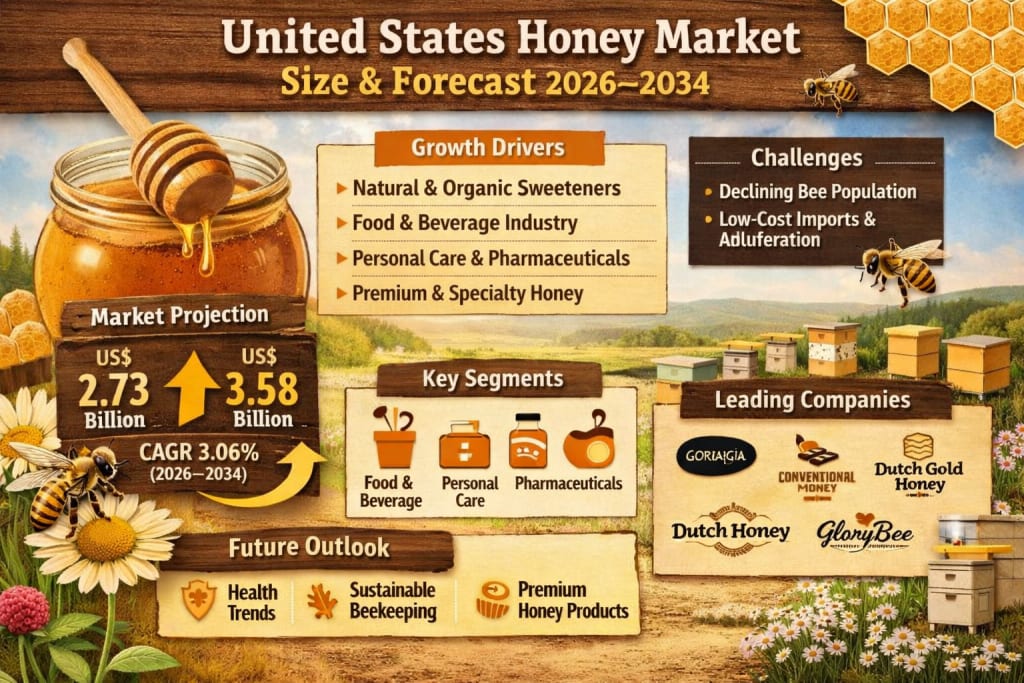
The United States honey market is experiencing steady growth as consumers increasingly shift toward natural and healthier food ingredients. According to industry estimates, the United States Honey Market is projected to grow from US$ 2.73 Billion in 2025 to US$ 3.58 Billion by 2034, expanding at a Compound Annual Growth Rate (CAGR) of 3.06% from 2026 to 2034.
This growth reflects broader changes in consumer behavior, particularly the rising demand for natural sweeteners, clean-label foods, and organic ingredients. Honey, known for its nutritional benefits and versatile applications, is becoming a preferred alternative to refined sugar and artificial sweeteners.
In addition to its role in food and beverages, honey is increasingly used in pharmaceutical products, health supplements, and personal care formulations. The growing popularity of functional foods, organic diets, and natural health remedies has further strengthened honey’s position in the American marketplace.
United States Honey Market Overview
Honey is a natural sweetener produced by bees from the nectar of flowers. Bees collect nectar, convert it into simple sugars, and store it in honeycombs where it matures into honey. This process creates a nutrient-rich substance that has been valued for centuries for its natural sweetness, medicinal properties, and nutritional content.
Honey contains antioxidants, vitamins, minerals, and antibacterial compounds that contribute to various health benefits. It is commonly used as a sweetener in beverages, baked goods, and cooking. Additionally, honey plays an important role in traditional medicine and modern wellness products.
In the United States, honey consumption has increased due to the growing awareness of healthier dietary choices. Consumers are reducing their intake of refined sugars and replacing them with natural alternatives. Honey fits perfectly into this trend because it is considered a clean-label ingredient with natural origins.
Beyond food uses, honey is widely used in cough syrups, skincare products, dietary supplements, and herbal remedies. As wellness and holistic health trends continue to grow, honey’s role in multiple industries is expanding rapidly.
Growth Drivers of the United States Honey Market
Increasing Consumer Preference for Natural and Organic Sweeteners
One of the most significant drivers of the honey market is the rising preference for natural and organic sweeteners. Consumers across the United States are becoming more health-conscious and are actively reducing their consumption of refined sugar and artificial sweeteners.
Health concerns such as obesity, diabetes, and metabolic disorders have encouraged consumers to explore healthier alternatives. Honey is widely perceived as a better option because it contains antioxidants, enzymes, and natural nutrients.
The clean-label movement has also played a major role. Consumers now prefer products with simple ingredient lists and recognizable natural components. Honey aligns well with these preferences, which has increased its popularity in food manufacturing.
Organic and raw honey varieties have become particularly attractive among health-conscious consumers. Food and beverage companies are increasingly incorporating honey into their products to meet these consumer expectations.
For instance, in March 2024, Honey Co. entered a strategic partnership with Wholesome Sweeteners, a leading supplier of organic sweeteners, to expand its product portfolio and reach a broader consumer base.
Expanding Applications in Food, Beverage, and Personal Care Industries
Honey’s versatility across industries has significantly boosted market growth. It is widely used in food, beverage, pharmaceutical, and personal care applications, making it a valuable ingredient in multiple sectors.
In the food industry, honey serves as a natural sweetener in products such as baked goods, breakfast cereals, sauces, snacks, and desserts. It enhances both flavor and nutritional value while also functioning as a natural preservative.
In beverages, honey is commonly used in tea, herbal drinks, energy beverages, and flavored health drinks. Its natural taste and perceived health benefits make it a popular ingredient in wellness beverages.
The pharmaceutical sector also relies on honey due to its antibacterial and healing properties. Honey is used in cough syrups, throat lozenges, and wound care treatments.
Similarly, the personal care industry has embraced honey for its moisturizing, soothing, and antioxidant properties. It is commonly found in skincare products such as facial masks, lotions, shampoos, and lip balms.
In June 2025, Burlap & Barrel introduced new single-origin spice blends and sweeteners at the Summer Fancy Food Show in New York City. The event showcased thousands of producers, buyers, and industry professionals, highlighting growing innovation within specialty food ingredients including honey.
Rising Demand for Premium, Raw, and Specialty Honey Products
Another key factor driving the honey market is the increasing demand for premium and specialty honey varieties.
Consumers are showing strong interest in high-quality honey products such as:
Raw honey
Organic honey
Manuka honey
Buckwheat honey
Local artisanal honey
These products are considered less processed and more nutritious compared to conventional honey.
Specialty honey varieties are often sold through health food stores, specialty retailers, farmers’ markets, and online platforms. Consumers are willing to pay higher prices for these products due to their perceived health benefits and authenticity.
In January 2024, Honey Co., a major industry player, launched an innovative product called “Honey Drops,” a single-serve honey packet designed for convenience and portability. This product highlights how companies are responding to modern consumer lifestyles and convenience-focused packaging.
Challenges of the United States Honey Market
Declining Bee Population and Environmental Challenges
Despite steady market growth, the honey industry faces significant environmental challenges.
One of the most serious concerns is the decline in bee populations. Bees play a critical role in honey production, and their declining numbers directly impact supply levels.
Several factors contribute to this issue, including:
Climate change
Pesticide exposure
Habitat loss
Diseases such as colony collapse disorder
These environmental pressures make it more difficult for beekeepers to maintain healthy colonies. Reduced bee populations may lead to lower honey production and increased market prices.
Additionally, changing weather patterns affect nectar availability, which can further disrupt honey production cycles.
To address these challenges, many producers are investing in sustainable beekeeping practices and environmental conservation efforts.
Availability of Low-Cost Imports and Honey Adulteration
Another major challenge for the U.S. honey market is the presence of low-cost imported honey.
Imported honey often enters the market at lower prices, making it difficult for domestic producers to compete. In some cases, imported honey may also be adulterated with added sugars or syrups.
Honey adulteration can damage consumer trust and negatively impact the reputation of the industry. It also creates unfair competition for genuine producers who maintain strict quality standards.
To remain competitive, domestic honey producers are focusing on product differentiation, branding, traceability, and quality certifications. Consumers are also becoming more aware of product authenticity and are increasingly choosing locally sourced honey.
United States Food & Beverage Honey Market
The food and beverage sector represents one of the largest applications of honey in the United States.
Food manufacturers use honey as a natural sweetener in products such as:
Breakfast cereals
Snack bars
Baked goods
Sauces and marinades
Yogurt and dairy products
Honey also plays a key role in beverages including tea, flavored drinks, and functional wellness beverages.
As consumer demand for natural ingredients increases, food companies are incorporating honey into their product formulations to create healthier and clean-label alternatives.
The rise of functional foods and immunity-boosting products has further strengthened honey’s role in this sector.
United States Honey Bottles Market
Packaging innovation has also contributed to the growth of the honey market.
Honey bottles, especially squeeze bottles, are increasingly popular because they offer convenience and reduce product waste. These packaging formats allow consumers to easily dispense honey without mess.
Manufacturers are also introducing eco-friendly and recyclable packaging solutions to align with sustainability trends.
Attractive packaging designs help improve product visibility in retail stores, which encourages impulse purchases.
The rapid expansion of online retail platforms and modern grocery stores has further increased demand for packaged honey products.
United States Organic Honey Market
The organic honey market in the United States is growing rapidly as consumers prioritize healthier lifestyles.
Organic honey is produced without synthetic chemicals, pesticides, or artificial additives. This makes it particularly appealing to consumers who value natural and environmentally friendly products.
Organic honey is widely used in:
Food and beverages
Skincare products
Natural health supplements
Consumers are often willing to pay premium prices for organic products because of their perceived health benefits and sustainability.
As the organic food industry continues to expand, organic honey is expected to remain a major growth segment in the U.S. market.
United States Conventional Honey Market
While organic honey is gaining popularity, conventional honey still dominates the market due to its affordability and wide availability.
Conventional honey is produced through traditional beekeeping methods and is commonly used in households and food manufacturing.
It is widely available in supermarkets, restaurants, and food service establishments.
Food manufacturers often prefer conventional honey because it offers consistent taste, reliable supply, and lower costs compared to specialty honey varieties.
Regional Insights: Key Honey-Producing States
California Honey Market
California is one of the leading honey-producing states in the United States. The state’s diverse agricultural landscape provides abundant nectar sources for bees.
Crops such as almonds, fruits, and vegetables support large-scale beekeeping operations. California also benefits from strong farmers’ markets and specialty food retailers that promote locally produced honey.
New York Honey Market
New York’s honey market is growing rapidly due to strong consumer demand for local and artisanal food products. Farmers’ markets and urban beekeeping initiatives have increased awareness and availability of local honey.
Restaurants and food processors in the state also use honey as a natural sweetener in various products.
Washington Honey Market
Washington’s diverse plant life and orchards provide excellent conditions for honey production. The state is known for producing distinctive specialty honey varieties with unique flavors.
Local markets and e-commerce platforms have further boosted honey sales across the region.
Georgia Honey Market
Georgia’s warm climate and abundant plant species create ideal conditions for beekeeping. The state produces various honey types, including wildflower honey and specialty varieties.
Growing awareness about sustainable agriculture and bee conservation is also supporting the expansion of honey production in Georgia.
Market Segmentation
Application
Food & Beverage
Personal Care & Cosmetics
Pharmaceuticals
Others
Packaging
Glass Jars
Bottles
Tubs
Tubes
Others
Processing
Organic
Conventional
Distribution Channels
Supermarkets/Hypermarkets
Convenience Stores
Online Retailers
Others
Key Companies in the United States Honey Market
Leading companies operating in the market include:
Comvita Limited
Barkman Honey, LLC
Johnston Home
Dutch Gold Honey
Adee Honey Farms
The Big Island Bee Company, LLC
Glory Bee Inc.
Crockett Honey Co., Inc.
Miller's Honey Company
These companies are evaluated across several parameters including company overview, key personnel, recent developments, SWOT analysis, and revenue performance.
Final Thoughts
The United States honey market is poised for steady expansion over the next decade. Growing consumer awareness about health and nutrition, along with the increasing popularity of natural ingredients, is strengthening demand for honey across multiple industries.
From food and beverages to pharmaceuticals and personal care, honey has established itself as a valuable and versatile natural product. While challenges such as declining bee populations and low-cost imports remain concerns, innovation in sustainable beekeeping, premium products, and specialty honey varieties will continue to support market growth.
With evolving consumer preferences and expanding applications, honey is likely to remain an essential ingredient in the United States’ health-conscious and natural food landscape through 2034 and beyond.
About the Creator
Hormone Replacement Therapy Market Size & Forecast 2026–2033
The global Hormone Replacement Therapy (HRT) market is witnessing steady expansion as healthcare systems increasingly focus on improving quality of life for aging populations. According to Renub Research, the Hormone Replacement Therapy market is projected to grow from US$ 23.72 Billion in 2025 to US$ 40.52 Billion by 2034, expanding at a compound annual growth rate (CAGR) of 6.12% between 2026 and 2034.
By shibansh kumarabout 13 hours ago in Trader
Shriram Finance Share: Stock Performance, Company Growth, and Investor Outlook
The Shriram Finance Limited has become one of the most discussed stocks in India’s financial sector. Investors looking for updates on Shriram Finance share are often interested in the company’s consistent earnings growth, strong lending operations, and expanding market presence. As a major non-banking financial company (NBFC), Shriram Finance has built a reputation for serving customers who often have limited access to traditional banking services.
By Hammad Nawaz3 days ago in Trader
Becca
"Everything is so... flat." Denille said stupidly as she looked around her new neighborhood. She looked around at the muted desert where even the smallest sign of life seemed to have given up. The plant life was shrubs that were half cooked by the heat and where there should have been a lawn, a mess of white rocks laid glistening in the sun. Even the sky looked stretched thin, like the sun had ironed it smooth. She’d moved from Riverside, where at least there were hills, but here in Barstow, everything felt baked and brittle.
By Sara Wilson8 days ago in Fiction


Comments
There are no comments for this story
Be the first to respond and start the conversation.