
City of plague:A new Yorker’s pandemic chronicle
Chapter6 The Pharmacy in Chinatown
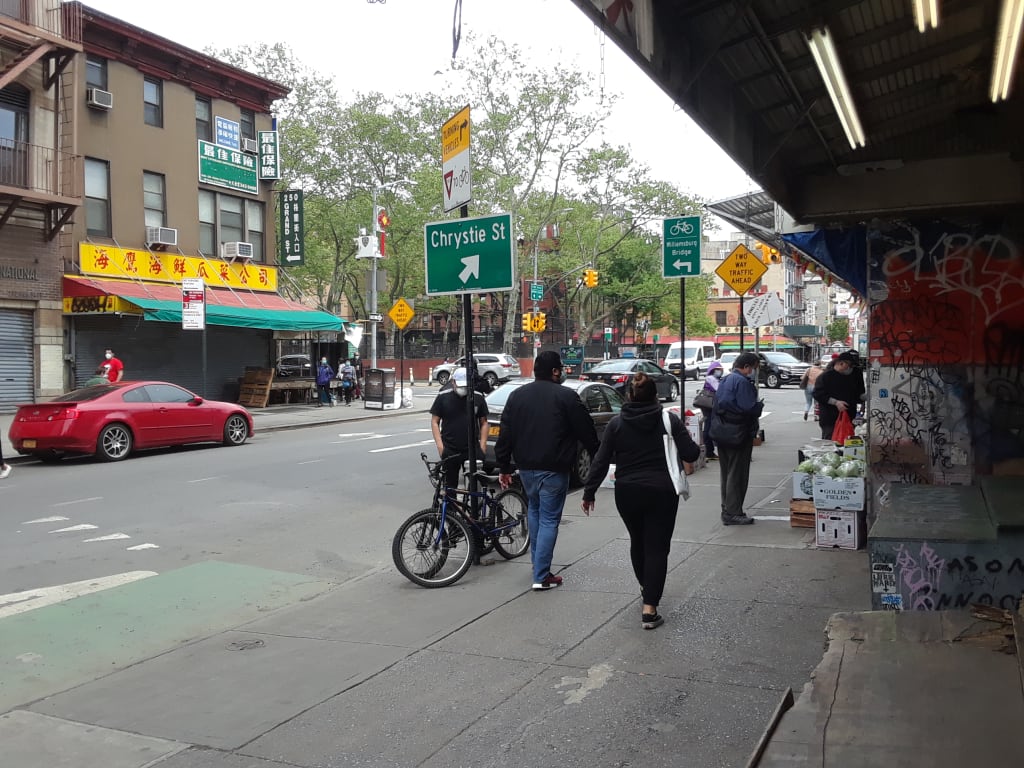
When Governor Andrew Cuomo ordered all non-essential businesses in New York State to shut down, Chinatown changed almost overnight.
Restaurants were allowed to offer takeout only—no dine-in service. Without the high margins from seated customers, many simply couldn’t survive. Delivery alone could not cover rent, payroll, utilities, and the growing risk of infection.
One by one, metal gates rolled down over storefronts.
Chinatown, once loud with steam, clatter, and argument, fell silent.
But pharmacies remained open.
They had to.
In Manhattan’s Chinatown, pharmacies seemed to outnumber grocery stores and banks combined. They sat on nearly every block, sometimes two within sight of each other. I used to wonder how so many could survive.
Now I understood.
In a pandemic, medicine becomes more essential than rice.
When President Donald Trump declared a national emergency on March 13, New York was already spiraling. Hospitals were overwhelmed. Emergency rooms overflowed with people who didn’t know whether their symptoms were mild or deadly.
Many were sent home to isolate.
Pulse oximeters. Thermometers. Tylenol. Cough syrup. Anti-nausea medicine.
Anything that might help became precious.
Soon, pharmacies were flooded.
One morning, I woke with a dull headache.
My body felt heavy. My nose was running.
I sat on the couch, staring at nothing.
What if this is it?
I turned to my wife.
“I think I might have COVID.”
She didn’t panic.
“You wear a mask more than anyone I know,” she said calmly. “It’s probably just a cold.”
She stepped closer and reached toward my forehead.
“Don’t come near me,” I warned. “If it’s COVID, you’ll catch it.”
“If it were COVID,” she replied, “I’d already have it.”
She felt my forehead.
“No fever. You’re fine.”
She used to work in a pharmacy back home and had seen every common illness. Her certainty steadied me.
Then I remembered—I had gotten caught in the rain the day before.
Perhaps it was nothing more than that.
Still, when I opened our medicine drawer, my anxiety spiked.
We had no cold medicine left.
On my way to work, I passed the neighborhood pharmacy.
The door was closed.
My heart sank.
Had even the pharmacies shut down?
I stepped closer and read the notice. The store had shortened its hours—10 a.m. to 3 p.m. Four fewer hours a day.
That afternoon, during my lunch break, I hurried back.
A long line stretched down the sidewalk.
I had thirty minutes. It wasn’t enough.
I gave up and returned to work.
When I finished early at 2 p.m., I tried again.
The line was shorter this time. After half an hour, it was my turn.
But customers were not allowed inside. A folding table blocked the entrance. Transactions were conducted outdoors, like black-market exchanges.
“Tylenol, please,” I said.
“Sold out,” the clerk replied, eyeing me carefully. “Do you need fever medicine?”
“I don’t have a fever,” I said quickly. “Just a cold.”
She relaxed slightly.
“For a regular cold, this will do.” She handed me a generic pain reliever.
I glanced at the price.
“Wasn’t this twelve dollars before?”
“Sir,” she said flatly, wearing both an N95 and a surgical mask, “soon even eighteen dollars won’t buy you anything.”
I paid without arguing.
Before leaving, I asked, “Do you have pulse oximeters? Thermometers? Hand sanitizer? Masks?”
She didn’t hesitate.
“All sold out.”
Of course.
I walked away quickly. If there was anywhere the virus might linger, it was here—where the sick gathered.
“Uncle, can you help me?”
The voice startled me.
I turned and saw an elderly woman, perhaps in her seventies, standing a few feet away.
In ordinary times, I would have stepped closer.
In these times, I stayed where I was.
“How can I help?” I asked.
“My groceries and medicine are too heavy,” she said. “Can you carry them home?”
I hesitated.
This was the worst moment for contact with strangers.
“Where do you live?”
“Just one street over,” she said, pointing.
As it happened, it was along my route home.
I studied her for a moment.
“Do you trust me?” I asked.
She smiled.
“I’m old,” she said lightly. “What is there left to be afraid of?”
I couldn’t argue with that.
“Alright,” I said.
I lifted her bags. She walked ahead; I followed at a careful distance.
Even kindness required geometry now.
It was indeed just one block away. The building had an elevator. I carried the bags to her apartment door.
As I turned to leave, she pressed a ten-dollar bill toward me.
“For you.”
I shook my head.
“It was nothing.”
I took the stairs instead of the elevator, wanting air, distance, escape.
Only once I was outside did I breathe fully again.
A few days later, when infection numbers began to stabilize, I saw her again on the street. This time she was walking with her home aide.
We passed each other.
She didn’t recognize me.
With my glasses and mask, I was just another cautious face in a cautious city.
And somehow, that felt right.
In those days, we helped one another quietly.
Not for recognition.
Just because we were all, in one way or another, carrying something too heavy alone.
About the Creator
Peter
Hello, these collection of articles and passages are about weight loss and dieting tips. Hope you will enjoy these collections of dieting and weight loss articles and tips! Have fun reading!!! Thank you.
Bomb Scare
It was 2027, and the world never thought it would happen. A missle hit the United States, but it wasn't where they had anticipated. A little town in the northeast was hit by a missile strike, they didn't know why, and they didn't know exactly where it hit, but they did know it was a coastal community, somewhere between Maine and Delaware.
By Gregory Payton7 days ago in Fiction
Worth the Wait: Puerto Viejo, Costa Rica
Beach bumming in a small Caribbean beach town sounded like a perfect way to end our 6-month trip through Mexico and Central America. Or so we thought. The foul, fishy stench of rotten seaweed hit our nostrils as we stepped from the cramped bus and looked out at a rather depressing, empty, and underwhelming black sand beach. It was pouring with rain, and we had to quickly fish out our ponchos. We thought, this couldn’t be it, could it?
By Sh*t Happens - Lost Girl Travel6 days ago in Wander


Comments
There are no comments for this story
Be the first to respond and start the conversation.