Fantasy
Echoes of Resistance
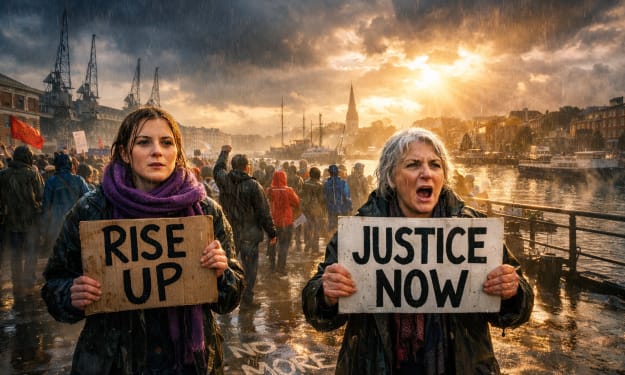
The streets of Bristol were alive that day, though not with the usual hum of buses and chatter, but with the heavy pulse of voices that demanded to be heard. I had not intended to join the protest—I came to observe, to write, to bear witness—but once I stepped into the swell of people, the energy was impossible to ignore. The banners waved above heads, each one a story, a demand, a prayer. The scent of rain-soaked asphalt mixed with the faint tang of chalk from hastily scrawled messages, leaving the air electric.
By imtiazalam3 days ago in Fiction
Gorgon's Purgatory. Content Warning.
A tingling sensation fills my head. A deep pressure builds into agonizing pain as the serpents swallow their midnight meal. They move their jaws in synchronized contractions, forcing the bodies of mice down their gullets. The mice wiggle within the snakes for what feels like an eternity, brushing the scaly, cold skin in a ballet of torture.
By Tas The Artist 3 days ago in Fiction
The Chosen; Chapter 6
I sit in our camp space glowering into the fire. We had been traveling for two days without any incidents. It was unsettling. Ahriman had known where we were. He had come after us and now nothing. Amara saw it as a sign that we had gotten away from him successfully, that we were now in the clear for the moment. To me, it felt more like we were in the eye of the storm.
By Katarzyna Crevan4 days ago in Fiction
The Clockmaker’s Secret. AI-Generated.
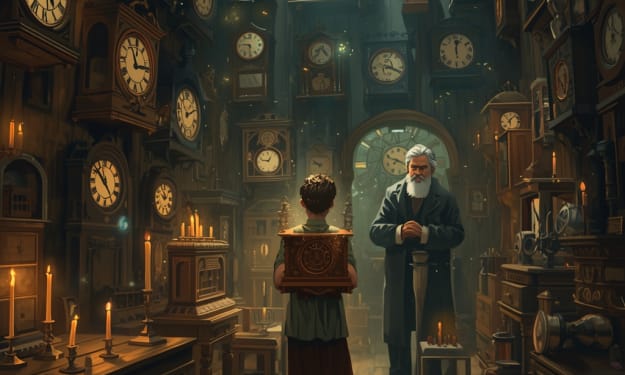
It was a rainy evening when Ayan first stumbled upon the little shop at the end of Maple Street. The sign read simply, “The Clockmaker”, in faded golden letters. Most people in town ignored it, dismissing it as another forgotten relic of the past. But something about the warm glow from its windows drew him closer, as if the shop itself was calling him. Inside, the air smelled of polished wood and old paper. Rows of clocks lined the walls—grandfather clocks, cuckoo clocks, pocket watches—all ticking in perfect harmony. Behind a cluttered counter stood an elderly man with silver hair, his eyes twinkling beneath thick spectacles. “Welcome,” the man said softly. “I’ve been expecting you.” Ayan froze. “Expecting me?” he asked, unsure whether to feel alarmed or amused. The clockmaker smiled. “Yes. Some gifts find their way to the right person. Come closer.” Hesitant, Ayan stepped forward. On the counter lay a small, intricately carved box, no larger than a loaf of bread. He couldn’t take his eyes off it. The carvings shifted subtly, almost like they were alive, telling stories of unknown lands and faces that seemed familiar yet unplaceable. “This,” the clockmaker said, “is not an ordinary box. It reveals what you need to see most, but only when the time is right.” Ayan reached out to touch it. The moment his fingers brushed the wood, the world around him blurred. The clocks stopped ticking, the rain outside ceased, and the room disappeared. He was somewhere else—a misty forest, dimly lit by a silver moon. A voice echoed softly: “The path you seek lies within. Choose carefully, for every choice carries a consequence.” Ayan blinked. Before him appeared two paths: one paved with golden leaves that shimmered even in the night, the other a dark, winding trail overgrown with roots and shadows. His heart raced. Something told him the golden path was tempting but perhaps misleading, while the dark path held a mystery he wasn’t yet ready to understand. He stepped onto the golden path first. The air smelled sweet, like honey and spring flowers. In the distance, he saw a small village. Children laughed and ran through cobblestone streets. Music floated from a tavern. It was perfect, serene… almost too perfect. And then he noticed the villagers’ faces. Blank. Empty eyes staring forward, smiling without joy. A shiver ran down his spine. Everything was beautiful, yet lifeless. He turned to leave, but the path had vanished. The golden leaves crumbled into dust under his feet. Panic surged through him. He ran, calling out, until the ground beneath him gave way. He fell into darkness. When he awoke, he was standing at the beginning of the dark path. The forest was silent, shadows stretching like fingers. Mist clung to the twisted trees, and somewhere in the distance, he could hear faint whispers—some pleading, some laughing, some crying. “Don’t be afraid,” a soft voice said again. He turned to see the clockmaker standing beside him, older somehow, as if the forest had aged him. “This path is harder, yes. But it shows truth.” Ayan took a deep breath and began walking. The shadows seemed to move around him, forming shapes: a little girl chasing a paper kite, an old man carving a wooden boat, a woman painting a window sill. Each scene shimmered like a memory—not his, but something close to it. A strange familiarity stirred inside him. At the heart of the forest, he found a lake so still it mirrored the sky perfectly. Floating above the water was a tiny key, glowing faintly. The clockmaker’s voice echoed again: “The key unlocks the box. But remember, what you unlock changes you forever.” Ayan reached out. The moment his fingers touched the key, a burst of light enveloped him. He was back in the shop, the clocks ticking once more. The box on the counter had opened. Inside lay a small, folded letter, written in a hand he didn’t recognize but somehow knew. “Courage is not the absence of fear. It is the choice to face what lies within. The life you seek is not in perfect beauty or fleeting pleasure—it is in truth, in every shadow you fear, in every joy you earn. Your journey begins now.” The clockmaker nodded. “Now you know. Every choice you make creates your story. Remember that, and never fear the dark, for it teaches what the light cannot.” Ayan left the shop that night with the box tucked under his arm. The rain had stopped, and the streets shimmered under the soft glow of lamps. But more importantly, something inside him had shifted. He understood that life was not about avoiding shadows, but learning to walk through them. And somewhere, deep in the ticking of the city’s clocks, he felt the whisper again: “Your story has just begun.”
By Zuzain Muhammad4 days ago in Fiction
The Frozen Pass Mystery: The Night Nine Hikers Ran Into the Darkness. AI-Generated.
In the winter of 1959, a group of nine university students decided to attempt a difficult expedition through a remote mountain range deep in northern Russia. The leader of the group was Arman Karev, a calm and experienced hiker known among his friends for planning tough but exciting adventures. Joining him were his close friends: Leonid Petrov, Sasha Morov, Nikolai Varenko, Yuri Sokol, Viktor Belin, Irina Volkova, Tania Orlov, and Mira Petrenko. All of them were skilled hikers. Some had already completed several winter expeditions before. None of them were beginners, and they knew exactly how dangerous the mountains could be in February. Still, adventure called them. They began their journey at the end of January, carrying heavy backpacks, cameras, journals, and enough supplies to survive the brutal cold. Their goal was to cross the frozen mountain pass and return home with stories of challenge and victory. During the first days of the expedition, everything seemed normal. Photos later recovered from their cameras showed the group laughing, walking through deep snow, and setting up camp under the pale winter sky. They looked happy, confident, and completely unaware of the mystery their journey would become. But after they failed to return on the scheduled date, worry began to spread. Days turned into weeks. Finally, search teams were organized to look for the missing hikers. When rescuers reached the area where the group was believed to have camped, they quickly found something strange. The tent was still there. But something about it felt wrong. The fabric of the tent had been cut open from the inside. Experienced hikers would never destroy their own shelter in the middle of a snowstorm unless something forced them to escape immediately. Outside the tent, the snow told a silent story. Footprints led away from the campsite. But the rescuers noticed something terrifying. Some footprints appeared to belong to people who were barefoot or wearing only socks. In temperatures far below freezing, leaving shelter without boots or coats would be almost certain death. The tracks continued down the slope toward a dark forest about a kilometer away. When searchers followed the trail, they discovered the first two bodies beneath a tall cedar tree. It was Yuri Sokol and Leonid Petrov. Near them were the remains of a small fire, as if they had desperately tried to warm themselves before the cold became too much. Between the tree and the abandoned campsite, three more bodies were found: Arman Karev, Sasha Morov, and Nikolai Varenko. Their positions suggested something heartbreaking. It looked as if they had been trying to crawl back to the tent before collapsing in the snow. Weeks later, after heavy snow began to melt, the remaining four hikers were discovered inside a nearby ravine. What investigators saw next made the mystery even darker. Irina Volkova had a fractured skull. Viktor Belin had several broken ribs. Mira Petrenko was missing her tongue. And Tania Orlov had severe internal injuries that looked similar to those caused by a powerful collision. Yet strangely, there were almost no external wounds. Even more confusing, there were no signs that anyone else had been present. No other footprints. No evidence of an attack. Some of the hikers’ clothing was later reported to have unusual radiation traces, adding another layer of mystery to the case. Over time, theories began to appear everywhere. Some believed a sudden avalanche might have terrified the group. Others suggested secret military tests happening in the mountains that night. A few locals even claimed they had seen strange glowing lights in the sky during the same period. But none of the explanations fully answered the biggest question. Why would nine trained hikers suddenly panic so badly that they cut open their tent and run into the freezing darkness? Years later, the case file was quietly closed with a strange explanation. Officials simply stated that the hikers died due to “an unknown and overwhelming force.” The mountain pass where the tragedy happened was later renamed Frozen Pass in memory of the lost hikers. Even today, hikers who visit the area say the place feels unusually quiet. The wind moves slowly through the snow-covered slopes, and the forest stands dark and still beneath the mountains. Some visitors say that standing there at night feels unsettling—almost as if the mountain is hiding something. Something that happened long ago. Something no one has ever fully understood. And perhaps never will.
By Baseer Shaheen 5 days ago in Fiction
The Silent Witness: A Cold Case That Remained Unsolved for 40 Years. AI-Generated.
The Discovery For Detective Elias Thorne, the Miller case was more than just a job; it was a ghost that haunted his career. The file was thin, yellowed, and smelled of decay—the kind of scent that only clings to papers locked away for four decades. In the autumn of 1984, the Miller family had simply vanished from their isolated farmhouse in Oakhaven. There was no struggle, no sign of forced entry, and no motive. Just a half-eaten meal on the kitchen table and a front door swinging open in the cold, biting wind. For forty years, the case remained a silent witness to a tragedy that had no perpetrator. The townspeople whispered about curses and vengeful spirits, but Thorne preferred cold, hard facts. The problem was that facts had been in short supply since 1984. The Cold Cellar The breakthrough came unexpectedly. During a routine renovation of the dilapidated farmhouse, a contractor pulled back a rotting floorboard in the master bedroom. Beneath it, resting in the dark, sat a small, rusted tin box. Inside, there was no money or jewelry—only a single, handwritten confession that ended with a chilling realization: the culprit hadn't left the house. Thorne felt a shiver run down his spine as he arrived at the scene. The house stood like a tomb in the middle of the forest. Inside, the air was heavy and stagnant. Thorne headed straight for the cellar. He had always felt that the police in 1984 had missed something, but he never expected to find what he did. As he shone his flashlight around the damp space, the beam landed on a thick, central stone pillar. It looked uneven, as if the masonry had been patched in a hurry decades ago. Thorne swung his heavy mallet, and with a few forceful strikes, the aged mortar gave way. The Dark Truth Behind the stone lay a hidden chamber, a cramped space that had been concealed from the world for half a century. It was not just a hiding spot; it was an archive of misery. Inside were personal items—watches, lockets, letters, and identity cards—that didn't belong to the Millers. They belonged to others who had vanished in the area over the last fifty years. The "Silent Witness" wasn't the house; it was the history buried within its foundations. The Miller family hadn't been the only victims; they had stumbled upon a serial predator who had been using the farm as a hunting ground for generations. Thorne sat on the cold floor, surrounded by the remnants of lost lives, realizing that some secrets are not just meant to be kept—they are guarded by the shadows themselves. The Haunting Realization In the corner of the hidden room, Thorne found a diary. Its pages were brittle, covered in frantic, messy scrawl. One entry, dated the day the Millers disappeared, sent a jolt of terror through him: "He is watching us from the walls. He never left. He is part of the foundation now." Thorne stepped back, his flashlight trembling. He realized that the mystery of the Millers had been solved, but in doing so, he had opened a door to a much larger, darker enigma. The silence of the Oakhaven farmhouse had finally been broken, but the truth was far more terrifying than the ghosts the town had imagined. Thorne turned to leave, but the heavy cellar door creaked shut behind him, cutting off the light. He knew then that the house was not empty. The silent witness was still watching, and for the first time in forty years, it had found a new guest.
By Baseer Shaheen 5 days ago in Fiction
A Dystopian Escape into Hope
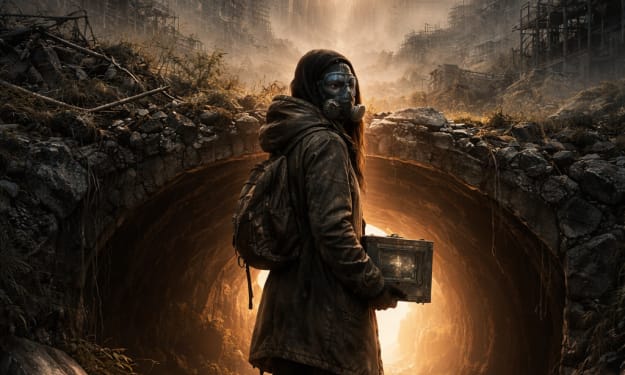
In the not-too-distant future, the world as we know it collapses. A once-thriving civilization, perched at the peak of technological advancements and power, crumbles under the weight of its own excesses. Greed, war, and environmental destruction ravage the Earth. What remains is a haunting, desolate world where only one city stands as the last bastion of human survival. But even this sanctuary, surrounded by decaying ruins and the remains of former glories, is on the brink of falling apart. The story of The Last Human City is a haunting narrative of survival, hope, and the resilience of the human spirit in the face of overwhelming odds.
By Jhon smith5 days ago in Fiction
The Iron Watch: The Silence That Chilled the North Sea. AI-Generated.
The North Sea does not forgive, and it certainly does not forget. In December of 1984, the storm was a beast. It howled like a wounded wolf, clawing at the glass of the lighthouse on the island known as 'The Iron Watch.' When the relief boat, the Aurora, finally managed to dock after five days of impossible waves, the crew expected to be greeted by the weary faces of the three keepers: Elias, the veteran; Silas, the quiet family man; and Bram, the youngest, who had only joined the service six months prior. Instead, they were met by a silence so thick it felt like a physical weight. Captain Miller and two others stepped onto the slippery stone quay. The iron door of the lighthouse was locked from the inside. After minutes of frantic hammering, they forced it open. Inside, the air was warm, smelling of burnt oil and old tobacco. A kettle sat cold on the stove. A chair lay overturned in the kitchen, but otherwise, everything was in its place. Except for the men. Miller climbed the winding spiral stairs to the lantern room. On the desk lay the official logbook. He opened it, his hands trembling. The final entry, dated December 15th, was written in Elias’s usually steady hand, but the ink was blotchy, the letters frantic: "11:00 PM: The storm is unlike anything I have ever seen. Silas has been praying for hours. Bram refuses to speak; he just stares at the waves. The glass is cracking. Something is knocking on the door. Not the wind. Not the sea. Something is knocking. May God have mercy on us all." The logbook ended there. There was no mention of an evacuation, no signs of a struggle. Just that final, chilling sentence. Elias had been a keeper for thirty years. He wasn't a man given to flights of fancy or religious hysteria. Silas was a practical engineer, and Bram was a cheerful lad with everything to live for. What could have reduced them to such a state of terror? As Miller looked out the reinforced glass of the lantern room, he noticed something strange. The iron railings, twenty feet above the highest recorded wave, were twisted like pieces of wet straw. A giant supply crate, weighing over five hundred pounds, had been moved fifty yards from its original spot and smashed into fragments. The search lasted for weeks. Divers went down into the freezing depths; helicopters scanned the jagged coastline of the surrounding isles. Not a boot, not a lifejacket, not a single trace was ever found. The theories began almost immediately. Some said the men had turned on each other, driven mad by the isolation and the relentless roar of the wind. Others whispered about a "Rogue Wave," a wall of water so massive it had swept them off the rocks in a split second. But the locals in the nearby coastal towns had a different story. They spoke of The Iron Watch as a place where the veil between worlds was thin. They whispered about the "Lament of the Deep," a sound that only lighthouse keepers can hear when the pressure of the sea becomes too much for the human mind to bear. In Silas’s room, Miller found a half-finished letter to his wife. "The sea is talking again, Mary," it read. "It sounds like the voices we lost. Bram thinks he sees lights under the water. I just want to come home." The mystery of The Iron Watch remains one of the greatest maritime enigmas of the 20th century. To this day, sailors passing the island claim they can see three faint lights flickering on the gallery—not the powerful beam of the lighthouse, but the small, rhythmic glow of three handheld lanterns, moving in perfect unison, waiting for a relief boat that will never arrive.
By Baseer Shaheen 5 days ago in Fiction