future
Exploring the future of science today, while looking back on the achievements from yesterday. Science fiction is science future.
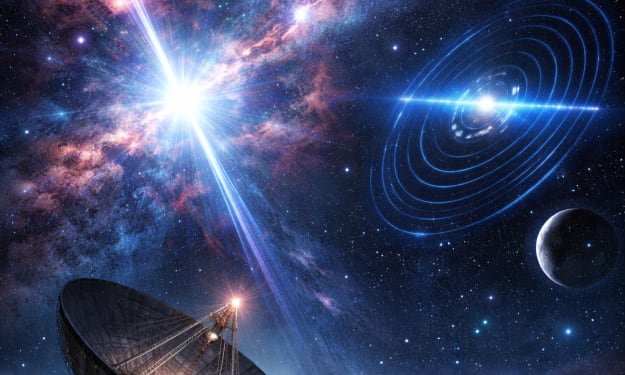
The Most Mysterious Signals from Deep Space Detected in 2026
The year 2026 has reinforced a long-standing truth in astronomy: the deeper we listen to the Universe, the stranger it becomes. Modern telescopes no longer simply observe distant stars and galaxies — they intercept brief, powerful, and often inexplicable signals that arrive from billions of light-years away. Some last only milliseconds, others pulse with eerie regularity, and a few originate from epochs when the Universe itself was still young.
By Holianyk Ihorabout a month ago in Futurism
A breakthrough in optics enables quantum computers to read data more quickly.
A novel method for simultaneously capturing light from numerous individual atoms has been developed by researchers, enabling the reading of their quantum information in tandem rather than one at a time.
By Francis Damiabout a month ago in Futurism
The reason behind the early 2020s methane increase
Although methane levels have been rising for some time, the early 2020s were particularly noteworthy. According to a recent study, levels surged abnormally quickly for a quite annoying reason. According to the research, the atmosphere's ability to remove methane temporarily deteriorated while nature was producing more of it.
By Francis Damiabout a month ago in Futurism
Robots Don’t Need Jobs. They Need Bodies.. AI-Generated.
I keep seeing the same mistake repeated in conversations about AI. Everyone assumes the next breakthrough will come from smarter models, faster chips, or humanoid robots that finally work outside lab demos.
By Ronnie Hussabout a month ago in Futurism
The Cities of Tomorrow: Living in a World Run by Robots
In the rapidly evolving landscape of urban development, robotics and artificial intelligence (AI) are no longer confined to laboratories or sci-fi movies. Today, they are poised to reshape the way we live, work, and interact within our cities. As we stand on the brink of this technological revolution, understanding the implications of robot-run urban environments is critical for both policymakers and citizens.
By muhammed salmanabout a month ago in Futurism
The "Wow!" Signal: The 72 seconds in 1977 when space finally spoke back.
The red ink bled into the grain of the fan-fold paper like a fresh wound. It was August 1977, but the air inside the control room of the "Big Ear" observatory in Ohio smelled of stale percolated coffee and the sharp, metallic tang of an overheated mainframe. Jerry Ehman didn't shout. He didn't gasp. He simply sat there, his eyes fixed on a vertical column of characters that shouldn't have existed.
By The Chaos Cabinetabout a month ago in Futurism
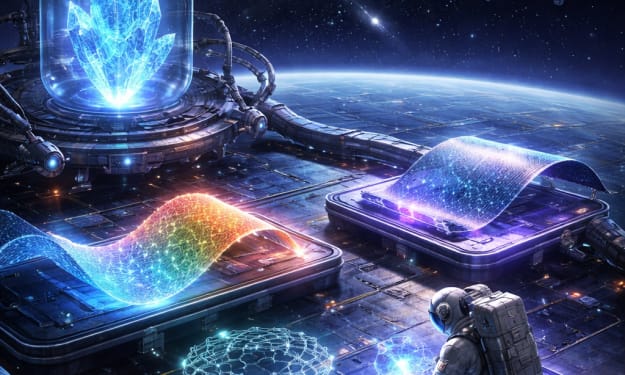
Materials That Only Work in Space: When the Universe Becomes the Laboratory
For most of human history, materials science has been constrained by Earth itself. Gravity shapes how crystals grow, air corrodes exposed surfaces, moisture seeps into polymers, and temperature changes happen gradually. But beyond Earth’s atmosphere lies an environment so extreme—and so different—that entirely new classes of materials can exist. Some of them do not merely perform better in space; they only function in space.
By Holianyk Ihorabout a month ago in Futurism