
The Night Polo of Emperor Akbar: When a Glowing Ball Lit Up the Mughal Game
How the Mughal emperor transformed the ancient sport of polo by introducing a glowing ball so matches could continue even after sunset.

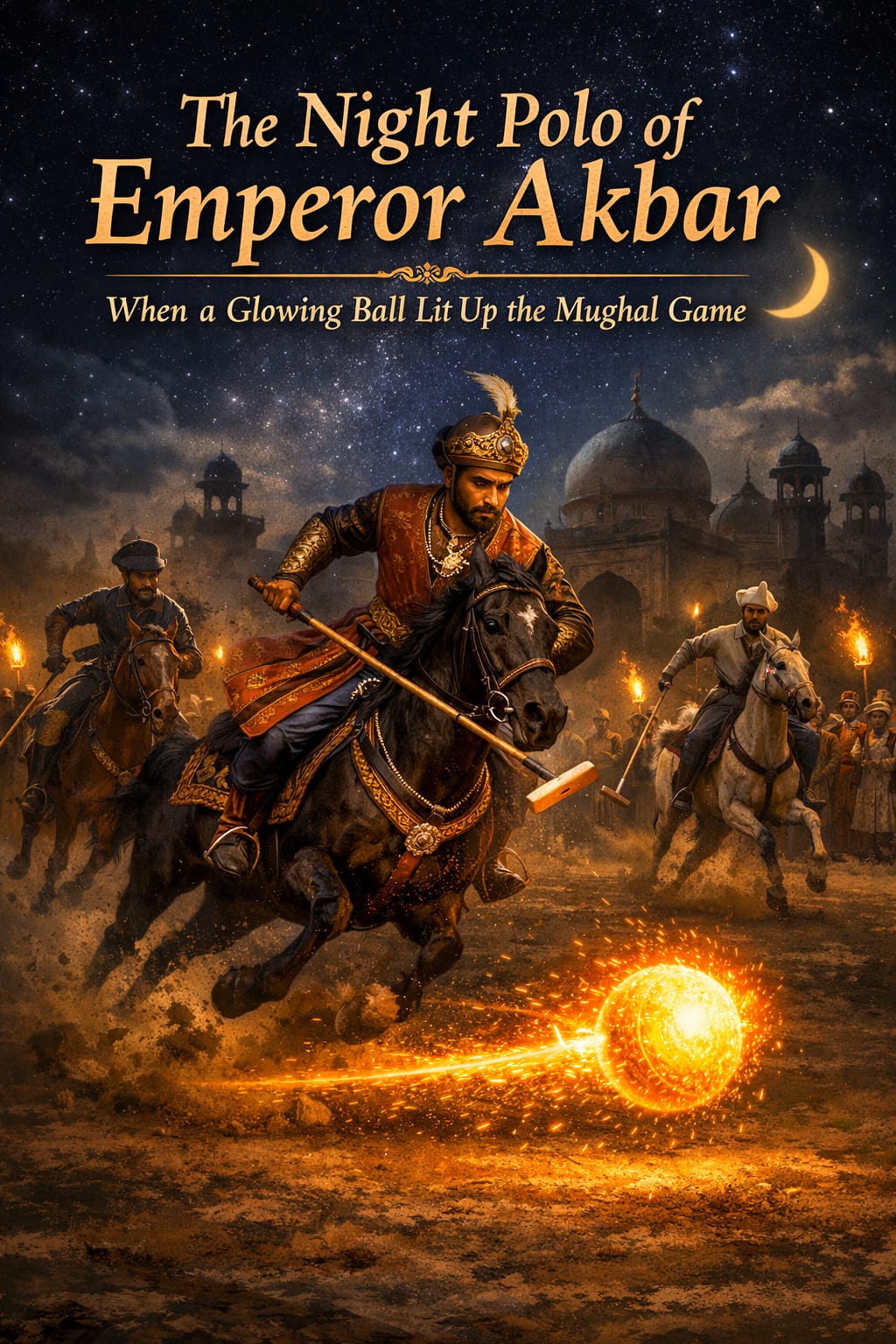
Among the many fascinating innovations associated with the Mughal Empire, one lesser-known yet remarkable story involves the love of sport displayed by the great emperor Akbar. Known for his administrative brilliance, military strength, and cultural openness, Akbar was also passionate about physical games—especially the ancient sport of polo, known in South Asia and Persia as chogan or chaugan. One of the most intriguing legends about him is that he introduced a glowing ball so the game could be played at night.
Polo itself has a very long history. The sport originated in ancient Persia more than two thousand years ago and spread across Central Asia and the Indian subcontinent through trade, migration, and conquest. By the time the Mughals established their empire in the 16th century, polo had already become a prestigious activity among nobles and warriors. It was not only entertainment but also a form of military training, as it improved riding skills, coordination, and strategic thinking.
Emperor Akbar, who ruled from 1556 to 1605, was deeply fond of the game. Historical records and court chronicles mention that he played polo frequently and encouraged his courtiers and soldiers to participate as well. However, Akbar’s enthusiasm for the sport sometimes exceeded the limits of daylight. Determined to continue the excitement even after sunset, he reportedly ordered the creation of a special ball that could glow in the dark.
According to historical descriptions, the ball used in night polo matches was made of wood and wrapped with materials that could hold fire or glow when ignited. Some accounts say that resin or oil-soaked cloth was used to create a small flame-like illumination. When struck across the field, the glowing ball would streak through the darkness like a moving star, allowing players to track it despite the night sky.
This innovation transformed the experience of the game. Imagine a wide open field under the night sky of Mughal India, with mounted riders racing across the ground while a fiery ball flashes between them. The scene must have looked spectacular—part sport, part theatrical display. Torches were also placed around the field to provide additional light, creating an atmosphere that must have amazed spectators.
Akbar’s nighttime polo matches were often attended by members of the royal court, military officers, and visiting dignitaries. These events were not only about recreation; they also demonstrated the emperor’s creativity and authority. By introducing new ways to enjoy traditional activities, Akbar reinforced the image of a ruler who encouraged innovation and cultural vitality.
The emperor’s fascination with polo was so strong that he reportedly had special polo grounds constructed in several cities across the Mughal Empire. Polo fields were established in royal complexes and military centers, allowing the sport to flourish among the elite. In some regions, it even became part of local traditions, influencing the development of polo in South Asia for centuries to come.
Beyond the novelty of a glowing ball, Akbar’s night polo games symbolized the spirit of experimentation that characterized his reign. The Mughal court was known for its openness to ideas from different cultures, religions, and regions. This attitude helped the empire develop a rich blend of Persian, Central Asian, and Indian influences in art, architecture, cuisine, and social life.
Akbar himself was famous for encouraging debate and curiosity. He welcomed scholars of different faiths to discuss philosophy and religion at his court and supported artistic and technological creativity. The night polo innovation may seem like a small detail, but it reflects this broader pattern of curiosity and experimentation.
Over time, polo continued to evolve and spread around the world. During the 19th century, British officers in India adopted the sport and later introduced it to Europe and other parts of the world. Today polo is played internationally, often associated with elegance and high society. Yet its roots remain deeply connected to the traditions of Central Asia and the Mughal courts.
The story of Akbar’s glowing polo ball therefore represents more than just an unusual sporting idea. It captures a moment when imagination met recreation in the royal courts of Mughal India. By transforming a daytime sport into a dramatic nighttime spectacle, Akbar demonstrated both his passion for the game and his willingness to experiment with new ideas.
In the grand history of the Mughal Empire, Akbar is remembered for major achievements such as administrative reforms, religious tolerance, and architectural wonders. But small anecdotes like the invention of night polo add a human dimension to his legacy. They remind us that even powerful emperors found joy in play—and sometimes illuminated the night with a ball of fire just to keep the game going.
About the Creator
Irshad Abbasi
Ali ibn Abi Talib (RA) said 📚
“Knowledge is better than wealth, because knowledge protects you, while you have to protect wealth.
Keep reading
More stories from Irshad Abbasi and writers in History and other communities.
India: Rajasthan Government Accused of Trying to Rewrite History Curriculum
A fresh controversy has emerged in India after allegations that the government of the state of Rajasthan is attempting to alter school history curricula. Critics claim the proposed revisions could significantly change how historical events and figures are presented to students, raising concerns about political influence in education and the rewriting of history.
By Irshad Abbasi about 7 hours ago in History


Comments
There are no comments for this story
Be the first to respond and start the conversation.