
When Diogenes Told Alexander the Great to Move – The Philosopher Who Asked a King for Sunlight
In one of history’s most famous encounters, the powerful conqueror Alexander the Great offered a favor to the philosopher Diogenes—and received a surprisingly blunt request

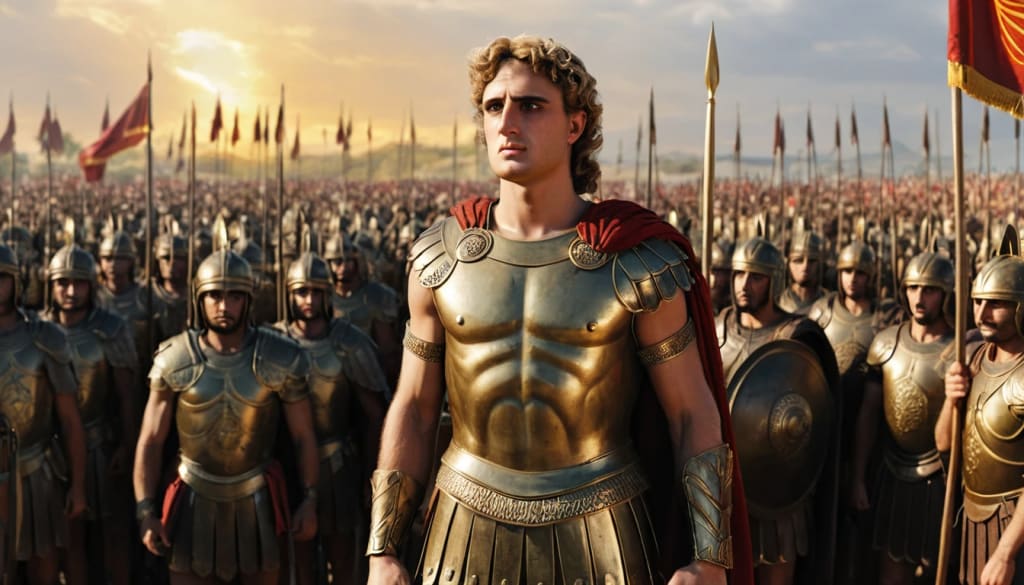
History occasionally produces moments so striking that they seem almost like scenes from a play. One of the most famous involves the meeting between the world-conquering king Alexander the Great and the unconventional Greek philosopher Diogenes of Sinope. The brief exchange between them has echoed through centuries as a symbol of independence, courage, and the strange power of philosophical simplicity.
Alexander the Great was one of the most powerful rulers the ancient world had ever seen. Born in 356 BCE in Macedonia, he inherited the throne from his father, King Philip II, and soon launched a series of military campaigns that reshaped the ancient world. His armies defeated the mighty Persian Empire and pushed as far as Egypt, Central Asia, and parts of India. Cities fell before him, kings surrendered, and entire regions came under his rule.
By the time he was still in his twenties, Alexander commanded enormous power and wealth. Wherever he traveled, people treated him with awe and reverence. Many considered him nearly divine.
Yet during one visit to the Greek city of Corinth, Alexander decided to meet a man who lived in almost complete poverty.
That man was Diogenes.
Diogenes of Sinope was one of the most unusual philosophers of ancient Greece. He belonged to a philosophical movement known as Cynicism, which taught that happiness and virtue could be achieved only by rejecting luxury, wealth, and social conventions. Cynic philosophers believed that most human desires were artificial and unnecessary.
Diogenes took this philosophy to dramatic extremes.
Instead of living in a comfortable house, he reportedly lived in a large storage jar or barrel in public spaces. He owned almost nothing. According to ancient stories, he carried only a cloak, a staff, and a small bag for food. At one point he even threw away his drinking cup after seeing a child drink water with his hands, concluding that the cup was an unnecessary possession.
His lifestyle shocked many people in ancient Greece, but it also fascinated them. Diogenes openly criticized social customs, mocked the wealthy, and challenged powerful figures with fearless honesty.
When Alexander arrived in Corinth, many philosophers gathered to greet him and pay their respects. Meeting the conqueror of the known world was an important event, and most scholars hoped to gain favor from the young king.
But Diogenes did not attend the gathering.
Instead, he remained lying comfortably in the sun.
Curious about this unusual philosopher who refused to visit him, Alexander decided to go see Diogenes personally. When the king and his entourage found him, the philosopher was reportedly resting on the ground, enjoying the warmth of the sunlight.
Alexander approached and introduced himself. In front of the famous philosopher, surrounded by soldiers and nobles, the young ruler offered a generous gesture.
He said that he admired Diogenes and would grant him any request he wished.
For most people, such an offer from the most powerful man in the region would have been an extraordinary opportunity. A request for wealth, land, or protection could have changed a person’s life forever.
But Diogenes had no interest in wealth or favors.
Looking up at the king, he calmly replied with a simple request:
“Stand out of my sunlight.”
Alexander had been blocking the sun.
The remark stunned those present. Few people in the ancient world would dare speak so casually to a powerful ruler, especially one known for commanding vast armies. The philosopher had effectively told the king of half the known world that the only thing he wanted from him was for him to move aside.
Yet instead of becoming angry, Alexander reacted with admiration.
According to ancient historians, he was impressed by the philosopher’s independence and courage. The encounter revealed a man who truly needed nothing from the powerful ruler standing before him.
Alexander reportedly responded with one of the most famous compliments ever given by a king. After leaving, he said:
“If I were not Alexander, I would wish to be Diogenes.”
The statement reveals how deeply the moment affected him.
In that brief exchange, two radically different visions of life stood face to face. On one side was Alexander, the conqueror who sought glory, empire, and historical immortality. On the other was Diogenes, the philosopher who rejected wealth, status, and ambition, believing that true freedom came from needing nothing.
Each man represented a different answer to the question of what makes a life meaningful.
Alexander pursued greatness through power and achievement. Diogenes pursued freedom through simplicity and self-sufficiency.
The encounter between them has fascinated historians for centuries because it captures this philosophical contrast in a single, unforgettable moment.
Although the exact details of the meeting were recorded many years later by ancient writers such as Plutarch and Diogenes Laertius, the story became one of the most celebrated anecdotes of classical history.
Whether every detail is perfectly accurate or partly legendary, the message of the story has remained powerful.
The philosopher who owned almost nothing demonstrated that independence of mind could rival the authority of kings.
And the king who ruled vast territories recognized the quiet strength of a man who needed none of his power.
Today the phrase “stand out of my sunlight” has become a symbol of intellectual courage and personal freedom. It reminds people that true independence sometimes lies not in possessing great wealth or power, but in being content with very little.
In a world where rulers commanded armies and philosophers often depended on patrons, Diogenes showed that a person could live entirely outside that system.
And for one brief moment in the sunlit streets of ancient Greece, the greatest conqueror of his age found himself politely asked to step aside.
About the Creator
Algieba
Curious observer of the world, exploring the latest ideas, trends, and stories that shape our lives. A thoughtful writer who seeks to make sense of complex topics and share insights that inform, inspire, and engage readers.


Comments
There are no comments for this story
Be the first to respond and start the conversation.