Biographies
The Man Who Read Saddam: John Nixon’s Intellectual Duel with a Dictator
For most intelligence officers, a target is a folder, a satellite image, or a series of encrypted communications. For John Nixon, Saddam Hussein was an architecture of the mind. From the moment Nixon joined the Central Intelligence Agency (CIA) in 1998, he didn’t just study Iraq; he inhabited the psychological space of its leader. What began as a professional assignment evolved into a career-defining immersion that would eventually lead to one of the most significant face-to-face encounters in the history of modern espionage.
By Irshad Abbasi 2 days ago in History
Saddam Hussein: The Final Hours of Iraq’s Iron Leader
The history of the 21st century has few images as stark as the fall of Saddam Hussein. For decades, he was the "Lion of Babylon," a man whose portrait hung in every office and whose shadow loomed over every street in Iraq. However, the narrative of his final moments—specifically the claim that even his American jailers wept during his execution—reveals a haunting layer of human complexity often lost in the geopolitical discourse of war and regime change.
By Irshad Abbasi 2 days ago in History
The Transformation of Saddam Hussein’s Basra Palace
For decades, the sprawling palatial complexes of Saddam Hussein were synonymous with fear, exclusion, and the absolute grip of a dictator. Built with opulent marble, intricate carvings, and vast artificial lakes during times of extreme economic hardship for the Iraqi people, these structures were forbidden zones—monuments to an ego that loomed over the Tigris and Euphrates. Today, however, one of these former bastions in the southern port city of Basra has undergone a radical metamorphosis. What was once a lakeside fortress for a tyrant has been reborn as the Basra Museum, a premier cultural institution dedicated to preserving Iraq’s 5,000-year-old history.
By Irshad Abbasi 2 days ago in History
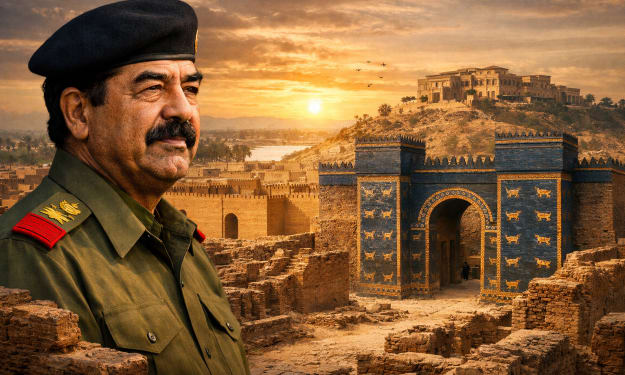
Saddam Hussein’s Fascination with the Ruins of Babylon
The ancient city of Babylon has long captured the imagination of historians, archaeologists, and travelers. Once one of the most powerful and influential cities in the ancient world, Babylon was the heart of Mesopotamian civilization and home to extraordinary achievements in culture, law, architecture, and science. Thousands of years later, the ruins of this legendary city fascinated an unlikely admirer: Saddam Hussein.
By Irshad Abbasi 2 days ago in History
Tilla Jogian: The Sacred Hill of Jhelum Where Kings, Saints, and Lovers Have Sought Their Prayers
In the rugged landscape of Punjab’s Potohar Plateau, overlooking the plains of Jhelum, rises a mysterious and historic hill known as Tilla Jogian. For centuries, this remote hilltop has drawn kings, saints, ascetics, and ordinary travelers who climb its steep paths seeking blessings, power, love, or spiritual enlightenment. The name “Tilla Jogian” literally means “Hill of the Yogis,” reflecting its long association with mystics who once meditated there in search of divine truth.
By Irshad Abbasi 3 days ago in History
Iran’s Final Warning
Iran’s Final Warning Tensions in the Middle East have reached one of the most dangerous levels in recent years as Iran issued strong warnings to both the United States and Israel during the ongoing conflict. Iranian military leaders and political officials say that if the attacks against Iranian territory continue, the war could expand far beyond its current battlefield.
By Wings of Time 3 days ago in History
Black Liberty on a Commemorative Coin: Redefining America’s Symbol of Freedom
In recent years, the United States has taken symbolic steps to reflect the diversity of its people in national imagery. One of the most notable examples came when the U.S. Mint introduced a commemorative coin depicting Liberty as a Black woman. For more than two centuries, Liberty—the personification of freedom in American iconography—had traditionally been portrayed as a white woman of classical European appearance. The introduction of a Black Liberty marked a significant shift in how the nation represents its ideals.
By Irshad Abbasi 3 days ago in History
Circumcision in Ancient Egypt: Ritual, Identity, and Medical Practice
Circumcision, the surgical removal of the foreskin from the male genitalia, is a practice that dates back thousands of years. Among the earliest civilizations known to have practiced circumcision were the ancient Egyptians. Evidence from archaeological discoveries, wall carvings, and historical writings suggests that circumcision was not merely a medical procedure in Ancient Egypt but a practice deeply embedded in religious beliefs, social identity, and cultural traditions.
By Irshad Abbasi 3 days ago in History
The World on the Brink
The World on the Brink: War Expands Across the Middle East The world is watching with growing concern as a major conflict spreads across the Middle East. What began as military strikes between Israel and Iran has quickly expanded into a broader regional crisis involving multiple countries and armed groups. Military actions, missile attacks, and political tensions are now affecting not only the Middle East but also global markets and international security.
By Wings of Time 4 days ago in History