social media
The scoop on social media for influencers, lobbyists, budding politicians and civilians with a stake in the Swamp's trending issues.
Public Announcement Challenge Winners. AI-Generated.
Public announcement challenges have become powerful platforms for discovering creative talent and amplifying messages that matter. From public health and environmental awareness to social inclusion and civic responsibility, these competitions invite individuals and organizations to craft announcements that inform, inspire, and influence behavior. This year’s Public Announcement Challenge winners stood out not only for their creativity, but also for their ability to turn complex issues into clear, compelling messages that resonate with diverse audiences.
By Sadaqat Aliabout a month ago in The Swamp
Brody King Just Turned AEW Dynamite Into A Political and Cultural Flashpoint by NWO Sparrow
How One AEW Star Triggered Raw Emotion Inside And Outside The Ring In my time covering pro wrestling , I have seen performers rise through story lines, title runs, and viral moments. Very few capture the kind of raw audience investment that feels larger than a match. Last night on AEW Dynamite, Brody King reached a level that transcended scripted competition. It felt bigger than wrestling, bigger than rivalry, and honestly bigger than AEW itself.
By NWO SPARROWabout a month ago in The Swamp
Ghazala Hashmi Makes History as Virginia’s Lieutenant Governor. AI-Generated.
In a historic moment for Virginia politics, Ghazala Hashmi has emerged as the state’s newly elected Lieutenant Governor, becoming the first Muslim woman to ever hold this prestigious position. Hashmi’s election marks a significant milestone not only for the state but also for the national political landscape, as it highlights the growing diversity of American leadership. Her achievement is especially notable in a time when the political scene is becoming more inclusive and reflective of the country’s diverse populace.
By Ayesha Lashariabout a month ago in The Swamp
TMZ Receives Alleged Ransom Note Linked to Savannah Guthrie’s Mother, Nancy: Unraveling the Mystery. AI-Generated.
Introduction In a shocking development that has stunned the public, TMZ has received an alleged ransom note supposedly tied to Nancy Guthrie, the mother of Today show anchor Savannah Guthrie. The note, which contains alarming and cryptic language, has sparked an intense media frenzy as both law enforcement and public figures work to understand the motives and origins of the threat. While the situation is still unfolding, the incident has raised questions about celebrity privacy, security, and the darker side of media attention.
By Ayesha Lashariabout a month ago in The Swamp
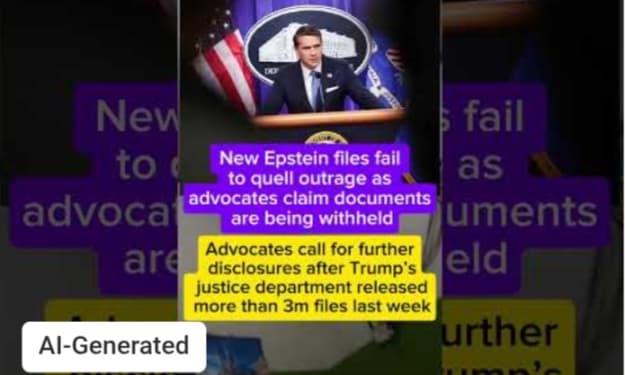
New Epstein Files Fail to Quell Outrage: Advocates Claim Key Documents Remain Withheld. AI-Generated.
The ongoing legal saga surrounding the infamous financier Jeffrey Epstein continues to cast a dark shadow over the world of politics, business, and law enforcement. Despite the release of new files by the U.S. government, critics argue that these documents fail to provide the full scope of Epstein’s criminal activities and those involved. Advocacy groups and legal experts claim that key evidence remains hidden, preventing a true reckoning of the circumstances that allowed Epstein’s abuse to persist for so long.
By Ayesha Lashariabout a month ago in The Swamp
The Smell of Fuzz. AI-Generated.
There is a smell that doesn’t come from flowers or rain or burning wood. It doesn’t rise from kitchens or factories or forests. It isn’t visible, yet everyone recognizes it the moment it appears. It hangs heavy in the air, sharp and unmistakable. It tightens the chest, slows the steps, and makes conversations suddenly quieter. People call it many things. Oppression. Surveillance. Fear. But on the street, in whispers and jokes, it has another name. The smell of fuzz. This smell appears long before sirens wail or boots hit the ground. It shows up before questions are asked, before doors are knocked, before anyone says, “You’re under arrest.” It’s the invisible signal that authority is nearby — watching, listening, waiting. And once you learn to recognize it, you never forget it. What Does “The Smell of Fuzz” Really Mean? At its simplest, “the fuzz” is slang for law enforcement. But the smell of fuzz isn’t about police cars or uniforms. It’s about presence without permission. It’s the feeling that someone else controls the space you’re standing in. You feel it when: A peaceful protest suddenly goes quiet Conversations lower their volume mid-sentence People instinctively check their phones, bags, and pockets Jokes stop being funny The smell of fuzz isn’t always tied to wrongdoing. Often, no crime is being committed at all. That’s what makes it powerful — and unsettling. It’s not about guilt. It’s about power. Fear Has a Scent Humans have evolved to detect danger without seeing it. Long before laws and governments, our ancestors learned to sense predators, storms, and threats through subtle changes in their environment. Today, the predator isn’t a wild animal. It’s uncertainty. The smell of fuzz is the modern equivalent of rustling bushes in the dark. Your brain asks the same ancient question: “Am I safe right now?” Even people who respect the law, even those who have never been arrested, feel it. Because fear doesn’t require wrongdoing — it only requires imbalance. Why Silence Follows Authority One of the strangest things about the smell of fuzz is how quickly it changes behavior. Laughter fades. Opinions soften. Truth becomes careful. People don’t stop talking because they are guilty. They stop talking because being misunderstood carries consequences. In many societies, authority doesn’t need to act harshly to be effective. It only needs to be present. The possibility of punishment is often more powerful than punishment itself. That’s why the smell lingers. The Thin Line Between Safety and Control Supporters of strong law enforcement argue — often correctly — that police presence can prevent crime, protect communities, and maintain order. Streets without rules can quickly become dangerous. But there’s a difference between safety and intimidation. Safety feels calm. Control feels tense. When authority reassures, people relax. When authority dominates, people withdraw. The smell of fuzz appears when the balance tilts too far toward control — when protection begins to feel like surveillance. Who Smells It First? Not everyone experiences the smell of fuzz equally. For some, it’s faint. For others, it’s overwhelming. History shows that marginalized communities often smell it first and strongest. People who have been stopped, searched, questioned, or targeted before develop a sharper sensitivity. To them, authority doesn’t represent neutrality. It represents memory. Memory of: Being assumed guilty Being watched without reason Being treated as a suspect before a citizen Once fear has a history, it returns faster. The Smell in the Digital Age Today, the smell of fuzz isn’t limited to streets and crowds. It has entered the digital world. You feel it when: Posts are deleted without explanation Accounts are shadow-banned Messages feel unsafe to send Algorithms quietly decide what is “acceptable” No sirens. No uniforms. No visible force. Yet the silence is the same. Digital authority doesn’t knock on doors — it reshapes reality. It decides what is seen, what is hidden, and what disappears. And yes, it has a smell too. When Protection Becomes Performance There’s another layer to the smell of fuzz: performance. Sometimes authority isn’t present to protect — it’s present to be seen. Riot gear at peaceful gatherings. Armored vehicles on quiet streets. Aggressive postures where none are required. This kind of presence sends a message, intentional or not: “We are in charge. Don’t forget it.” The smell intensifies not because of danger, but because of theatrics. Why People Joke About It Humor is a survival tool. When people joke about “the fuzz,” they’re not being disrespectful — they’re reclaiming a small piece of control. Laughter weakens fear. Nicknames shrink authority to something manageable. But jokes also reveal truth. If authority felt universally fair and humane, it wouldn’t need a slang name whispered under breath. Can the Smell Be Washed Away? Yes — but not easily. The smell of fuzz fades when trust replaces fear. When authority is transparent, accountable, and human, its presence feels different. Trust grows when: Questions are answered, not punished Power is explained, not imposed Mistakes are acknowledged, not denied Communities are partners, not targets When people believe they will be treated fairly, the air changes. Listening Changes the Air The most powerful antidote to the smell of fuzz isn’t force — it’s listening. When authority listens, people speak. When people speak, fear loosens. When fear loosens, trust can grow. Listening doesn’t weaken authority. It legitimizes it. Why This Conversation Matters Some will say: “If you’re not doing anything wrong, you have nothing to fear.” History disagrees. Many of the world’s darkest chapters were written under systems where “doing nothing wrong” offered no protection. Rights exist precisely because innocence alone is not enough. The smell of fuzz reminds us of that truth. The Smell as a Warning System Rather than dismiss it, we should treat the smell of fuzz as a signal — not of criminality, but of imbalance. When people feel watched instead of protected, something needs attention. When silence replaces dialogue, something is broken. Ignoring the smell doesn’t make it disappear. It only makes it stronger. A Different Kind of Presence Imagine authority that smells like: Calm instead of tension Confidence instead of dominance Service instead of control That kind of presence exists in some places. It proves the smell of fuzz is not inevitable — it’s a result of choices. Choices about tone. Choices about power. Choices about humanity. Final Thoughts: Naming the Smell Matters To name something is to acknowledge it. “The smell of fuzz” is more than slang. It’s a shared human experience, a quiet understanding passed through generations. It tells us when power feels heavy and trust feels thin. If we want safer societies, we must aim not just for order — but for dignity. Because the best kind of authority doesn’t announce itself with fear. It walks in quietly… and the air stays easy to breathe.
By Zahid Hussainabout a month ago in The Swamp
Global Consumer Electronics Market Size & Forecast 2025–2033: Smart Devices, Connectivity, and the Next Digital Wave. AI-Generated.
Global Consumer Electronics Market Overview The Global Consumer Electronics Market is entering a new era of accelerated digital transformation. According to Renub Research, the market is expected to grow from US$ 1,196.45 billion in 2024 to US$ 2,099.93 billion by 2033, expanding at a CAGR of 6.45% during 2025–2033. This growth reflects the world’s increasing dependence on smart devices, advanced connectivity, and integrated digital lifestyles.
By Sakshi Sharmaabout a month ago in The Swamp